You've noticed it, haven't you? Dad's a bit quieter these days. The workmates drifted off when he retired. The phone doesn't ring the way it used to. He's fine, he says he's fine, but the days feel longer for him now, and you catch yourself wondering what he does with all of them.
You're not overthinking it.
Here's the honest part, including the bit that's hard to sit with. Staying connected in later life doesn't happen by itself. It used to be built in, through work, the footy club, the street you'd lived on for forty years. When those threads loosen they don't always reweave on their own, and no amount of practical help around the house fixes it. A cleaner coming on Tuesdays is a good thing. It is not company.
The good news is that there's a whole movement built for exactly this, and there is almost certainly a shed near you. CareAbout is proud to support and sponsor the Men's Shed. Here's why.
What a Men's Shed actually is
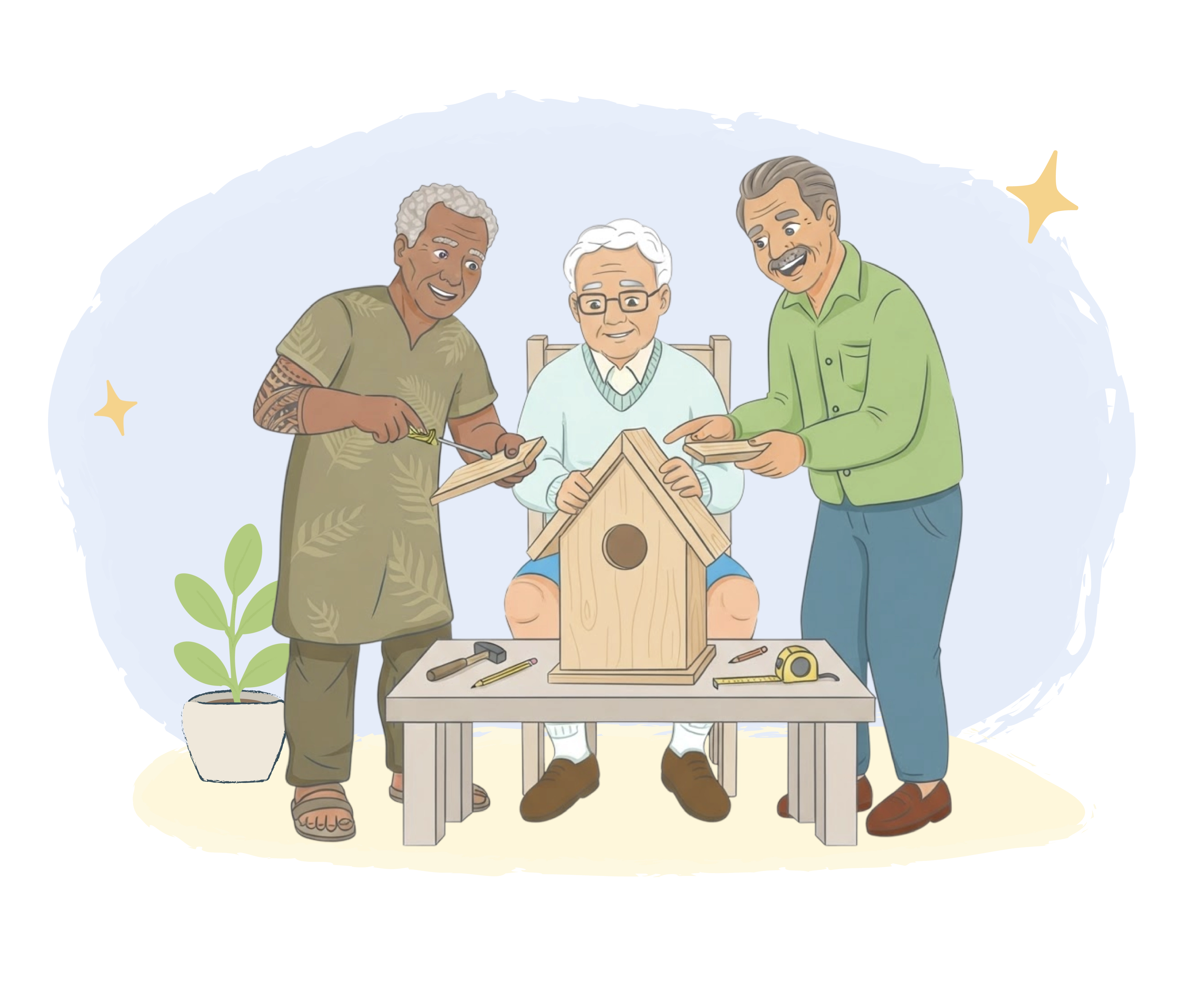
Strip away the name and it's simple: a shed, a workbench, a kettle, and a room full of men who are glad you turned up.
It's not a clubhouse with a rulebook. Some days it's a woodworking project. Other days it's a cuppa and a conversation and nothing more, and that counts just as much. The line that became the Men's Shed motto came from Professor Barry Golding, speaking at the second National Men's Shed Conference in 2007: men don't talk face to face, they talk shoulder to shoulder.
It's not a service you apply for. No assessment, no eligibility form, no funding tier, no waiting list. A Men's Shed is a community organisation, not an aged care program. You don't need My Aged Care, an aged care needs assessment, or anyone's permission to walk through the door. After months of navigating a system that requires all of those things, that alone can come as a relief.
The first Men's Shed opened in Goolwa, South Australia, in 1993. There are now more than 1,300 around the country and over 60,000 men taking part. For a lot of them it's the one reliable reason to get up, get dressed and get out, and to be somewhere a familiar face is expecting them.
Why connection is part of care
The common misreading. Families tend to think of "care" as the practical stuff: the cleaning, the showering, the someone-comes-on-Tuesdays support. That matters enormously, but it's only half of it. A dad who has help around the house and nobody to talk to isn't being well cared for. He's being maintained.
This isn't a soft claim. The World Health Organization treats social isolation and loneliness as neglected social determinants of health, and says research shows they seriously affect physical and mental health, quality of life and longevity. Around 11.8 per cent of older people experience loneliness. So when you worry about Dad being on his own, you're worrying about his health, not just his mood.
What belonging actually does. A Men's Shed gives men a place to learn something new, pass on what they know, and be useful to someone else. That last one is the part people underestimate. A lot of what retirement takes away isn't activity, it's being needed.
Supporting connection and community through the Men's Shed
At CareAbout, we believe that supporting older Australians is about more than helping people access care. It's also about helping people stay connected to their communities, maintain friendships and continue doing the things that give life meaning.
That's why we're proud to support and sponsor The Men's Shed.
Our partnership with the Men's Shed allows CareAbout to contribute to this important work by providing resources, encouragement and practical support that help the organisation continue making a positive difference in the lives of its members.
We believe strong communities are built through connection, by creating places where people feel supported, valued and included. Working alongside wonderful community organisations like the Men's Shed is one of the ways CareAbout can play a small part in strengthening those connections.
A Men's Shed isn't an alternative to care at home, and it isn't funded by any care program. It sits alongside whatever help Dad already has. He can have both.
What to do next
Have the gentle version of the conversation. Not "you need to get out more". More like "there's a shed up the road, want to take a look one morning?" Low stakes, no commitment.
Find the nearest one. Use the Find a Shed tool at mensshed.org, or call 1300 550 009. Turning up unannounced is normal. Most sheds will hand a first-timer a cuppa before they've finished explaining themselves.
Name connection when you plan care. If you're sorting out support for Dad, talk about how he's spending his days, not only what he needs help with. Social support and transport are fundable services in their own right, so it's worth raising.
You don't have to work this out alone
If you've been quietly carrying the worry about Dad, the long days, the fading phone calls, the sense that he's slipping out of his own life a bit, you're not imagining it and you're not overreacting.
Our help is free and it's one-on-one. No script, no pressure, just a real conversation whenever you're ready. If it's useful, we'll go through what Dad is likely to be eligible for and which vetted providers actually service his area and have capacity. That's a shortlist built around his needs, never a ranking of who is "best".
What it comes down to is simple. Dad gets to keep being part of something. Useful, included, expected somewhere on a Tuesday morning.
Whenever you're ready, today, next week or three months from now, we're here.