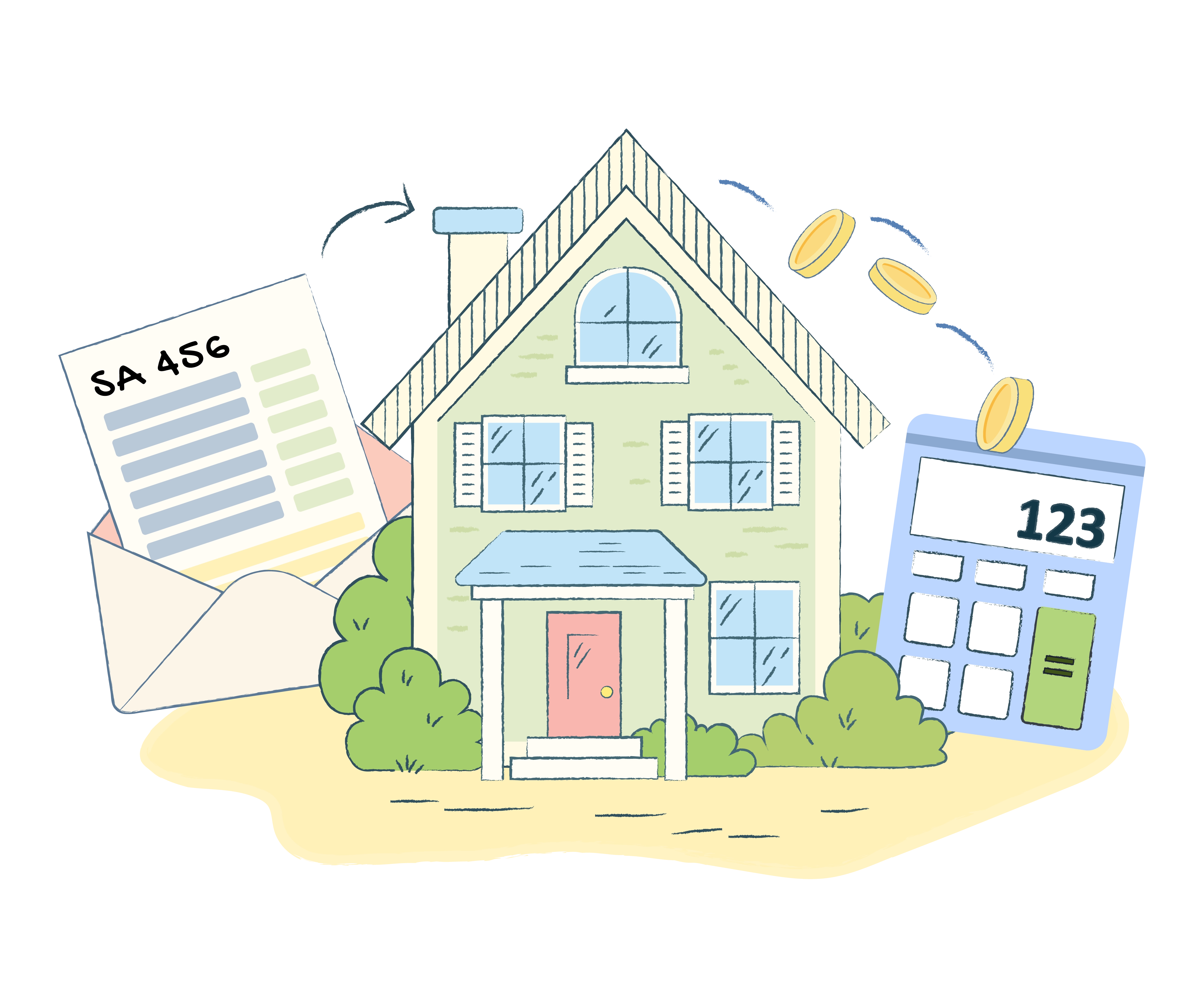
Someone has mentioned the SA456, or the PDF is sitting open in another tab. Twenty pages, with questions about bank accounts, funeral bonds and even the caravan. A lot for some help with the cleaning.
You are not imagining it. It does look big. It is also much simpler than it looks.
Here is the plain answer. The SA456, the Support at Home calculation of your cost of care form, tells Services Australia what you earn and own so it can work out your share of the cost of Support at Home services. It does not decide whether you get care. Plenty of people never need to fill it in, and for those who do, whole sections are skipped with a single No.
The good news is that it follows a predictable pattern, and the result lands in one of three outcomes. Let's walk through it plainly.
If you already get the Age Pension, you can probably put the form down
Services Australia already holds the financial details of anyone on a means-tested payment, such as the Age Pension, Disability Support Pension, Carer Payment or DVA Service Pension. They do not need the SA456, as long as their details were updated in the last two years and nothing has changed. Update them through myGov or on 132 300.
One thing to be clear on: the Age Pension (Blind), Disability Support Pension (Blind) and War Widow(er)s Pension are not means tested, so people on those do fill it in. So does almost every self-funded retiree.
Saying no to the form means paying the top rate
Question 15 asks whether you want to provide income and asset details at all. You can tick No. But you are then "means not disclosed", and your provider can charge the maximum contributions until you reach the lifetime cap, $140,652.80 as at 20 September 2026.
If you would land on the top rate anyway, the form changes nothing. Otherwise, skipping it may cost you more money for some services.
Gifts, bank accounts and couples are where people trip up
- The home is not counted. For Support at Home, Services Australia only needs to know whether you own your home, not what it is worth.
- List every account, even the ones earning nothing. Accounts and investments are deemed to earn income whatever they actually pay.
- Gifts from the last five years still count. Anything over $10,000 in a financial year, or $30,000 over five, is treated as an asset you still hold.
- Couples are assessed on half. Combined income is split down the middle, whoever's name it is in.
The letter puts you in one of three bands, and the band sets your rate
Services Australia then sends a letter with your rate for each service category. Pensioners get the same letter, from what is on file.
- Full pensioner: 0% on clinical supports, 5% on independence, 17.5% on everyday living.
- Part pensioner, or self-funded with a Commonwealth Seniors Health Card: 0% clinical, 5% to 50% independence, 17.5% to 80% everyday living, tapered by income and assets.
- Self-funded without the card, or means not disclosed: 0% clinical, 50% independence, 80% everyday living.
Clinical supports cover nursing, occupational therapy, podiatry and, since 1 October 2026, help with showering or dressing where approved in the support plan. They are 0% for everyone but still draw on the quarterly budget, which caps how much you receive. Independence covers things like transport and respite. Everyday living is cleaning, gardening and meals.
Sit with what that means for a moment. On a cleaning visit priced at $100, a full pensioner contributes $17.50. A self-funded retiree without the card contributes $80. Same visit, same provider. The only difference is the letter.
Self-funded and unsure about the card? Our guide to the self-funded retiree income assessment covers it, and the Support at Home contributions calculator gives a dollar figure before the letter arrives. Anyone on or approved for a Home Care Package by 12 September 2024 pays the same or less under the "no worse off" rule.
What to do next
- Apply online if you can. Services Australia's step-by-step guide walks through it in myGov. Submit within 13 weeks of starting or it expires. The paper SA456 is there if online is not an option.
- Do it before services start. The letter is valid for 120 days. If services start first, the rate is backdated and the provider must refund any overpayment.
- Get authorised if you are helping someone. They sign, or a financial power of attorney signs with photo ID. The SS313 form at the back lets you call for them: "I'm the authorised person for [name], calling about their cost of care assessment."
- Check the date on every figure, including these. The lifetime cap changes every 20 March and 20 September.
- Report changes within 28 days on the Aged Care line, 1800 227 475, Monday to Friday, 8am to 5pm.
- Do not give money away to lower the rate. Gifts over the limits keep counting for five years, and the money does not come back.
You don't have to work this out alone
It is a lot. Feeling overwhelmed is not a failure. It is a reasonable response to a genuinely confusing setup.
Having a chat with our team is free to you. It is one-on-one, a real conversation rather than a script, with no pressure to decide anything. When you are ready, we match you with providers that fit what you actually need, never a ranking of who is "best".
Here is what it usually comes down to. Most people fill the form in once, get a letter with three percentages, and only revisit it when their finances or living situation change. That is not a consolation prize. It is just how it generally works.
What matters is the person you care for getting help at home, and you back to being family instead of a full-time case manager.
Whenever you are ready, today, next week or three months from now, we are here.