It is 9.40pm. The kids are finally down. You have got a work thing due in the morning that you have not started, and there is a load of washing that has been in the machine since yesterday. Your phone goes. It is Mum, and she has had another fall. Not a bad one. She is fine. She just wanted to tell someone.
You say the right things. You tell her you will call in the morning. And then you sit on the edge of the bed for a while, working out how you are going to fit a doctor's appointment into a week that was already full before the phone rang.
You are not the problem here.
Here is the honest answer up front, including the part you might not want to hear. There is no arrangement where all of this becomes easy. Being pulled between a parent who needs more and children who still need you is genuinely hard, and no amount of organising makes that untrue. What there is, though, is a very large amount of funded support that most families in this position never claim, because nobody tells you it exists and you are too flat out to go looking.
The good news is that the support is real, the process has a clear first step, and a decent chunk of it is aimed at you rather than at your parent. Let's walk through it plainly.
The Sandwich generation explained
The phrase for it is the sandwich generation: caring for ageing parents and raising children at the same time, usually while working. It tends to land in your forties and fifties, and it tends to arrive gradually rather than all at once. You start with a bit of shopping. Then it is the appointments. Then it is the medications, the bills, the phone calls to the bank, the slow realisation that you are the person holding all of it.
Most people in this position do not think of themselves as carers. They think of themselves as a daughter or a son who is a bit stretched. That matters more than it sounds, because almost every piece of funded support in this country is attached to the word "carer", and if you do not use the word, you do not get offered the help.
You are a carer. You do not need a diagnosis, a letter, or your parent's agreement to call yourself one. If you are regularly doing things your parent can no longer do alone, you qualify, and doors open once you say so.
The first step is an aged care needs assessment
This is the gate. Your parent cannot get government-funded aged care at home without one, and nothing else in the system moves until it is done. You can apply for an aged care assessment here.
One thing to be clear on, because a lot of information still gets this wrong: ACAT no longer exists. Aged Care Assessment Teams were folded into the Single Assessment System on 9 December 2024. There is now one assessment pathway, carried out by an aged care assessor. If a friend or a website tells you to "book an ACAT", they are describing a system that has been gone for nearly two years. You are looking for an aged care needs assessment.
You start it through My Aged Care on 1800 200 422. The registration call covers your parent's health, living situation and what they are finding difficult. You can make this call with your parent sitting beside you, and in most cases you can make it for them.
Ask to be registered as their representative on the same call. This is the step almost every explanation skips, and it is the one that catches families out. Without it, My Aged Care will not discuss your parent's file with you, and you will spend the next six months putting your mother on the phone to repeat information she has already given twice. Being registered means you can call, chase, and receive correspondence yourself.
Assessments are often done over the phone now, which is quicker – but a phone call is a hard place to show anyone how your mum is really managing. You can ask for a face-to-face assessment at her home instead, and it's worth doing. Then try to be there. Not to answer for her, but because most older people significantly understate how much they're struggling in front of a stranger with a clipboard, and you're the one who knows what the last six months have actually looked like.
Say the specific thing, not the general thing. "Mum's not managing well" tells the assessor almost nothing. "She's had two falls since June, she's stopped showering unless I'm there, and I'm driving forty minutes each way three times a week to sort her medications" tells them exactly what to fund.
Then say the other half out loud: what happens when you can't keep doing it. Assessors take the support already in place into account, which means a family quietly holding everything together can read, on paper, as someone who's managing fine. If the driving and the showering and the medication sorting are only happening because you're doing them – and that isn't something you can keep up alongside work and your own children – say so plainly, and say when it has to change.
That isn't gaming the system. It's describing it accurately.
What your parent will actually pay
This is where most families stall, because they assume the answer is either "nothing" or "everything", and neither is right.
Under Support at Home, which replaced Home Care Packages on 1 November 2025, services are split into three categories and your parent contributes a different percentage to each one.
Clinical supports are fully government funded. Nursing care, occupational therapy, podiatry, and, since 1 October 2026, personal care such as help with showering and dressing. Your parent contributes nothing towards these, regardless of income or assets. Two caveats are worth knowing. Personal care is only free if it has been approved as a service type in your parent’s support plan, so it has to be raised at the assessment rather than added later. And "no contribution" does not mean unlimited: clinical supports still come out of the quarterly budget, so the budget is the real limit, not the price.
Independence supports cover transport, respite, remedial massage and help to get to appointments or social events. A full pensioner contributes 5 per cent. A self-funded retiree contributes up to 50 per cent.
Everyday living supports cover cleaning, meals, gardening and home maintenance. A full pensioner contributes 17.5 per cent. A self-funded retiree contributes up to 80 per cent.
So for a parent on the full age pension, the great majority of what they receive is either free or close to it. The percentages are set by an income and assets assessment through Services Australia, and they do not vary by provider. A provider quoting you a different contribution rate is quoting you something else, and it is worth asking what.
If your parent was already on a Home Care Package, or was approved for one, on or before 12 September 2024, the "no worse off" principle applies. They will not pay more under the new arrangements than they would have under the old ones. Worth raising if their statements suddenly look different.
There is also a lower tier worth knowing about. The Commonwealth Home Support Programme covers entry-level help such as cleaning, transport, meals and a bit of personal care. There is no formal means test. The provider sets a modest fee, and it is often the fastest way to get something in place while a Support at Home budget is still being sorted out.
Respite is not a luxury, and it is not a last resort
Respite is the piece that families in the sandwich almost never use until they are already past breaking point. It is designed to be used well before that.
Respite at home means a paid carer comes to your parent's house, during the day or overnight, so that you can go to your child's school concert, or a medical appointment of your own, or nothing at all. It is funded through both the Commonwealth Home Support Programme and Support at Home.
Day respite takes place at a day centre or community space, usually around 10am to 3pm, and often includes transport there and back. For a lot of older people it turns out to be the social contact they were missing rather than the care.
Residential respite is a stay in an aged care home, typically a couple of weeks. Your parent is entitled to up to 63 days of subsidised residential respite in a financial year, covering both planned and emergency stays, and it can be extended in some circumstances. This is the one that makes a holiday possible, or covers you after your own surgery. It requires an assessment, though in a genuine emergency a provider can arrange an urgent one.
Emergency respite exists and it is a phone call. If you are suddenly unable to care, through illness, a crisis, or something happening with your own children, ring Carer Gateway on 1800 422 737. They arrange emergency respite at home, in the community, or in an aged care home.
Someone is meant to be looking after you too
Carer Gateway is free, it is federal, and it is for you rather than your parent. Call 1800 422 737, Monday to Friday, 8am to 5pm. It offers counselling, peer support groups with other carers, coaching, and in some cases practical help like help around the house or assistance getting to appointments. Your parent does not need to be assessed, approved or receiving anything for you to use it.
Most people in the sandwich generation discover Carer Gateway years later than they should have, usually from another carer. There is no queue-jumping involved and no assessment of your parent required. It is a phone call on a weekday.
Check whether you are eligible for Carer Payment or Carer Allowance through Services Australia. Plenty of people assume they earn too much or do not do enough hours, do not apply, and turn out to have been eligible the whole time.
What to do next
This week. Call My Aged Care on 1800 200 422, start the assessment, and ask to be registered as your parent's representative on the same call.
This week, separately. Call Carer Gateway on 1800 422 737. Ask what is available in your area.
Before the assessment. Write down the last six months in specifics. Dates of falls. Missed medications. How many hours a week you are spending. Assessors fund what they are told, not what they infer.
Do not wait for the crisis. The families who cope best are not the ones with more resources. They are the ones who started the assessment before it was urgent, because the assessment takes time and a hospital discharge does not wait for it.
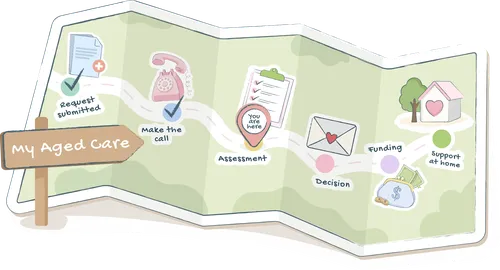
What happens after your assessment?
After the assessment, waiting for an update can feel like another thing to manage. Knowing how to follow up can help you understand where things stand and what comes next. For practical steps, read here.
You don't have to work this out alone
Feeling stretched to the point of resentment, and then guilty about the resentment, is not a failure of character. It is a reasonable response to being asked to do two full-time jobs at once inside a system that assumes someone is free during business hours to make phone calls.
If you would rather talk it through with someone who does this every day, that is what we are here for. CareAbout is free to you. You will speak to a real person, not a script, and we will go through your parent's situation, what they are likely to be eligible for, and which vetted providers actually service their area and have capacity.
It is a shortlist built around your parent's needs, never a ranking of who is "best". There is no pressure to decide anything on the call, and it is completely fine if the answer today is that you are just gathering information.
What most people tell us afterwards is not that the paperwork got easier. It is that they got to stop being the case manager for a while and go back to being someone's daughter, or son, with enough left over for their own kids at the end of the day.
Whenever you are ready, today, next week or three months from now, we are here.