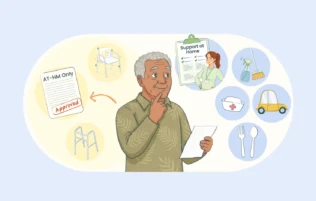
Sally’s Choice: Security And Support at Home Over ‘Just Getting By’ With CHSP
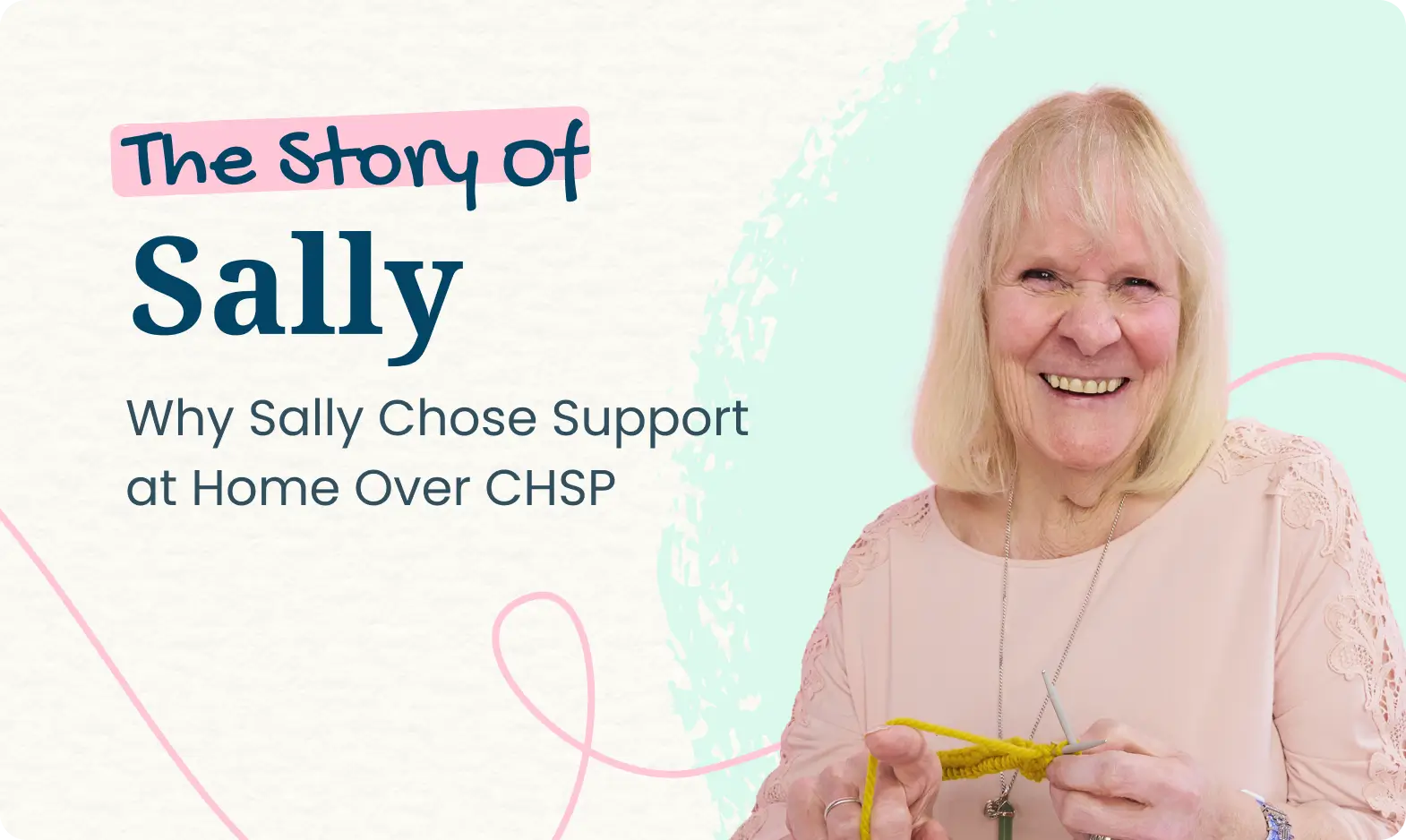
Many older Australians hesitate when they hear the terms “Home Care Package,” or more recently, “Support at Home,” often assuming such change comes with a higher cost associated – but the reality, is far from that.
Instead, Support at Home can provide you with even more support for the same cost (or even less out of your pocket).
Let’s take a look at Sally’s story, and why she chose a transitional Level 2 package under Support at Home instead of staying with the Commonwealth Home Support Program (CHSP).
Meet Sally: A CHSP Client Who Wants to Stay At Home
Sally is a full pensioner with low but ongoing support needs. She lives alone and wants to stay in her own home for as long as possible.
Under the Commonwealth Home Support Program (CHSP), Sally currently receives:
- Cleaning support at $12 per hour out of pocket.
- Nursing support at $15 per hour out of pocket.
These services keep her home manageable and help her stay safe. However, CHSP availability has not always been reliable. Sally has had cleaning visits missed at short notice and on one occasion a missed clean contributed to a minor fall because clutter built up. She is already a little nervous about change, but she also knows she cannot afford more disruptions to essential help at home.
The New Offer: A Transitioned Level 2 Home Package (Classification) With A Deadline
Sally has recently been approved for a Level 2 package and is considered a transitional customer under the Support at Home changes.
The key dates and numbers are:
- Approved for a Level 2 package on 4 April 2025.
- Assigned a package on 20 October 2025.
- Package expiry date of 15 December 2025, giving her 56 days from assignment to decide.
- Annual Level 2 budget of $19,319 as a transitioned customer.
This funding is designed to support someone like Sally who has low but ongoing needs. It can pay for cleaning, nursing and many other supports, as long as she is linked with a provider and accepts the package before the assignment expires.
That Moment When: “But, How Can I Afford These Hourly Rates?”
Sally sits down with the matched provider to talk through her care plan and receives a draft budget.
On the page are the provider’s standard hourly rates:
- $105 per hour for cleaning.
- $185 per hour for nursing.
She instantly compares these to her familiar CHSP rates of $12 and $15 per hour and feels sick with worry. In her mind she jumps straight to,
“I just cannot pay $105 or $185 an hour. I will be worse off.” This is a very common reaction. The important point is that provider rates are not the same as what Sally pays out of her own pocket. To see the real picture, she needs to look at her co-contribution rules.
Fact One: What Sally Now Pays Under CHSP
First, it helps to set out her current CHSP situation clearly so she has a proper baseline.
Right now, Sally’s out-of-pocket costs look like this:
| Service | What Sally Receives | Sally’s Hourly Cost Under CHSP |
|---|---|---|
| Cleaning | Regular home cleaning to keep her home safe and tidy | $12.00 |
| Nursing | Clinical support when needed (e.g. wound care, medication support) | $15.00 |
If Sally has one hour of cleaning and one hour of nursing, her total out-of-pocket cost is currently $27 per “combined hour” of support.
Fact Two: How Transitional Co-Contributions Change the Numbers
As a transitional full pension participant, Sally does not pay the full provider rate.
Sally only pays a percentage of that rate, and the rest is covered from her Level 2 package budget. Under the transitional settings:
- Her co-contribution for nursing is 0%.
- Her co-contribution for everyday living services such as cleaning is 17.5%.
That means the real question is not “How much does the provider charge?” but “What percentage does Sally actually pay?” When we apply these percentages to the provider’s rates, Sally’s actual hourly costs under the package look like this:
| Service | CHSP Hourly Cost to Sally | Provider Hourly Rate (Package) | Sally’s Co-Contribution Rate | Hourly Cost to Sally Under Package |
|---|---|---|---|---|
| Cleaning | $12.00 | $105.00 | 17.5% | $18.38 |
| Nursing | $15.00 | $185.00 | 0% | $0.00 |
The calculation is simple but powerful. For cleaning, 17.5% of $105 equals $18.38 per hour, so Sally’s cleaning cost rises by $6.38 compared with CHSP. For nursing, 0% of $185 equals $0, so her nursing becomes free at the point of care.
Fact Three: Comparing the Total Cost Per Hour of Support
Most of Sally’s worry comes from hearing that cleaning will cost her more per hour.
However, she rarely receives cleaning without nursing over a whole year. What matters is the combined effect across all the support she needs.
When we look at the total cost of an hour of cleaning plus an hour of nursing under both systems, this is what we see:
| Scenario | Sally’s Cleaning Cost (Per Hour) | Sally’s Nursing Cost (Per Hour) | Total Sally pays (per hour of both) | Difference Vs CHSP |
|---|---|---|---|---|
| Commonwealth Home Support Program (CHSP) | $12.00 | $15.00 | $27.00 | – |
| Transitional Level 2 (Classification 2) Package | $18.38 | $0.00 | $18.38 | $8.62 saving per hour |
This is the key myth-busting moment. Even though her cleaning cost goes up by $6.38 per hour, her nursing cost drops by $15 per hour.
Overall, she saves $8.62 for every combined hour of cleaning and nursing compared with what she pays now under CHSP.
Fact Four: The Hidden Value Beyond the Cost
The money alone is a strong reason to accept her package, but the non-financial benefits make the case even stronger.
By moving onto a Level 2 package with this provider, Sally also gains:
- Consistent staff and fewer missed visits: Sally is more likely to see the same cleaners and nurses who know her routines, preferences and risks at home. This reduces the chance of missed visits and situations like the missed clean that contributed to her earlier fall.
- Access to more hours of care as needs change: Because she has a package budget of $19,319 per year, she can adjust how that budget is used. If she needs more cleaning, personal care or nursing over time, she and her provider can alter her care plan rather than hunting for one-off services.
- A broader menu of services: Her package can support more than just cleaning and nursing. Over time, she may draw on allied health, home maintenance, social support and other services that help her stay at home, without having to juggle multiple disconnected programmes.
Fact Five: A Care Partner To Stand in Sally’s Corner
Another important change is that Sally will have a Care Partner linked to her package. This person will:
- Visit Sally at home about every three months;
- Check in on Sally to see how her services are working, and whether or not Sally’s goals are still being met;
- Help adjust Sally’s mix of services if her health or personal preferences change;
- Support her to seek a higher-level package in future if her needs increase.
Instead of feeling like she must work through the system alone, Sally has someone whose sole role is to help Sally to continue living safely at home (and to make sure her funding keeps pace with her needs).
Sally’s Choice: From Living In Fear to Feeling Confident
At first, all Sally could see were three big numbers: $105, $185 and the looming expiry date of 15 December 2025.
Once Sally’s provider walked her through the tables and explained her transitional co-contributions, Sally could see that:
- Her personal cost for the same mix of cleaning and nursing falls from $27 to $18.38 per combined hour.
- Nursing, which is one of her most important supports, becomes free for her.
- She gains consistent staff, more flexibility and regular help from a Care Partner.
What Sally’s Story Means for Other CHSP Care Recipients
Sally’s case shows that headline provider rates are not a good guide to what a client will actually pay.
For transitional full pensioners in particular, co-contribution settings can cut personal costs substantially, even when provider rates are high.
When you lay out the numbers in simple tables and add in the value of steady staff, more hours, extra services and a Care Partner, the picture changes completely.
If you or someone you support is in a similar position, the practical lesson is simple:
- Ask your provider to set out a side-by-side comparison of CHSP and package costs for the services you actually use, just as Sally did.
- Make sure you understand your co-contribution percentages, not just the provider’s rate sheet.
- Consider the safety and peace-of-mind benefits of regular staff and a care partner, not just the dollar figure for one service.
With the right information, a Support at Home package (Classification) stops looking like a financial risk and starts looking like what it is for Sally: A smarter, safer and more affordable way to stay at home for longer. And if you have any further questions or need support, we’re here to CareAbout you – simply contact us below, or freecall at 13 13 00.