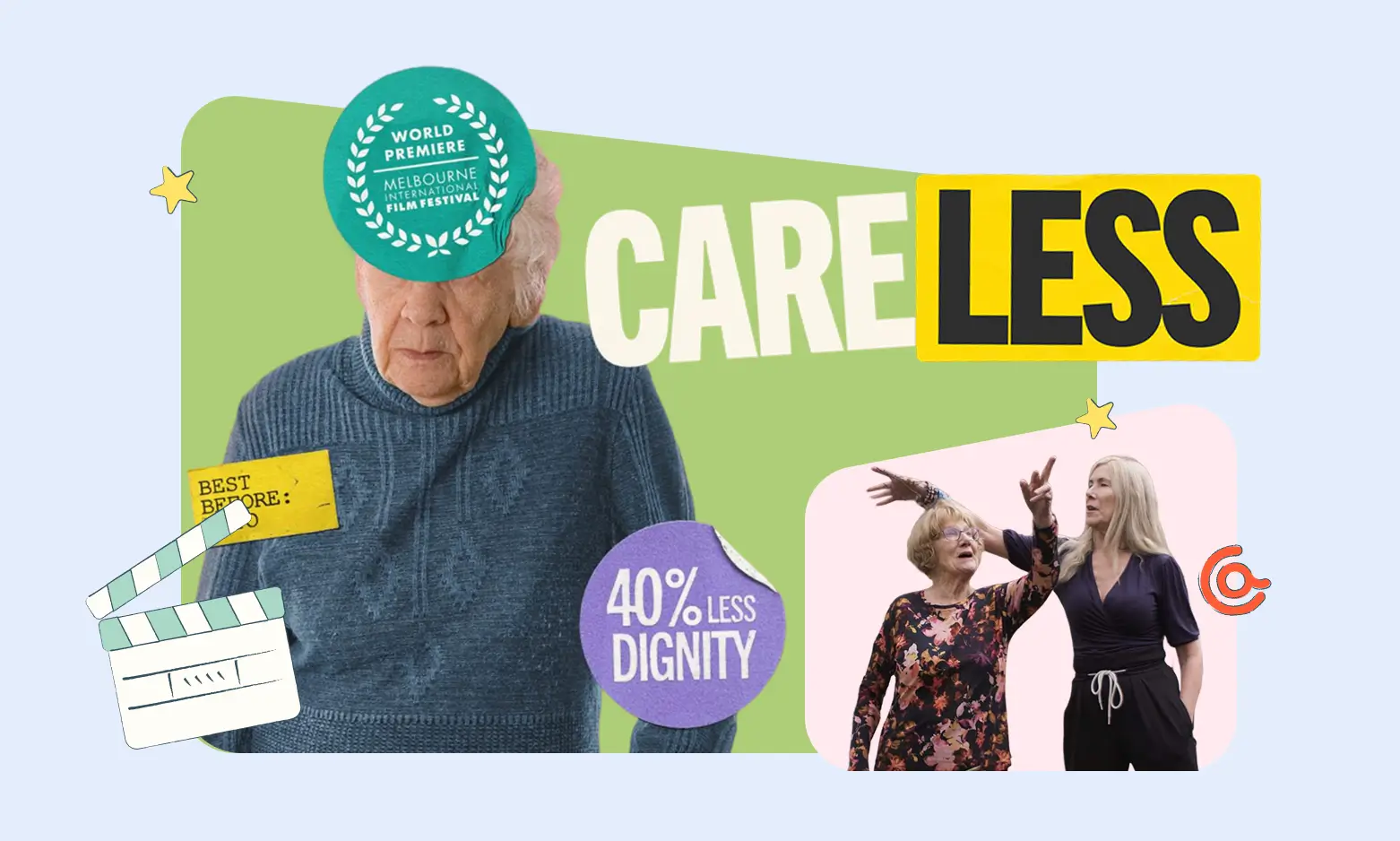
Careless (2025) is a new Australian documentary now streaming on Netflix – and if you’re caring for an ageing parent, or navigating the aged care system yourself, it might be the most seen you’ve felt in a long time.
There’s a moment early in Careless where filmmaker Sue Thomson is helping her 89-year-old mother Margaret navigate a world that doesn’t quite know what to do with her. It’s not dramatic. It’s not cinematic in the way you’d expect. It’s just…real.
And if you’ve ever tried to help a parent hold on to their independence whilst the system nudges them toward a facility, you’ll feel it in your chest.
What Is Careless About?
Directed by Melbourne-based producer-writer, Sue Thomson, Careless follows a handful of older Australians who are determined to grow old on their own terms and ultimately, stay out of ‘the system.’
At the heart of this documentary, is Thomson’s own mother, Margaret, whose wit and warmth anchor the whole film. Margaret doesn’t want to go into aged care. She wants to stay home. And watching her daughter try to make that possible (whilst unpacking just how broken the system is), makes for documentary filmmaking that is equal parts heartbreaking and oddly funny.
Alongside Margaret’s story, we meet Olivia, 94, and her long-distance daughter Jane. We meet Hanh, a care navigator, and her client Beverly. And we meet Luciana and Mario, an Italian-Australian couple, still deeply in love, desperate to stay at home together.
Each story is different, but the thread is the same: older Australians who want dignity, autonomy, and a say in how they live — and a system that doesn’t always make that easy.
Why This Documentary Matters Right Now
If you’ve been following the aged care conversation in Australia, you’ll know it’s been a rough few years. The Royal Commission into Aged Care exposed systemic failures. The transition from Home Care Packages to Support at Home has left many families confused. And the new Integrated Assessment Tool (IAT) has been compared to robodebt by clinicians and advocates.
Careless doesn’t just scratch the surface. It goes back decades – tracing how 40 years of bipartisan privatisation turned ageing into big business. Poet Sarah Holland-Batt, whose own father experienced abuse in residential care, puts it bluntly in the film: ‘It really is a story of provider influence.’
Thomson herself has said that ‘when we’ve handed off responsibility to the market, the market is interested in making a profit.’ It’s not a revelation – most families dealing with aged care already suspect this. But hearing it laid out so clearly, with real people’s stories as evidence, hits differently.
It’s Not All Heavy, There’s Warmth Here Too
One of the things that makes Careless genuinely special is its refusal to be bleak. Thomson uses an unexpected narrative device through a group of young schoolgirls serve as a kind of Greek chorus, explaining systemic problems whilst riding merry-go-rounds and speaking to classrooms. It’s playful and oddly moving. Children making sense of a mess that adults created.
And Margaret herself is a joy. Sharp, funny, stubborn in the best way. She’s not a victim – she’s a person fighting to live her life. You’ll recognise her. She might remind you of your own parents.
FilmInk Australia rated Careless 8 out of 10, calling it ‘a strong documentary, underlined with humour, hope and compassion.’ It won the Intrepid Audience Award at the Melbourne International Film Festival in 2025. That’s not just critics deciding it’s important – that’s a room full of real people saying, this moved me.
What Careless Gets Right About Caring
There’s a particular kind of exhaustion that comes with caring for an ageing parent. It’s not just physical. It’s the weight of decisions that don’t have good options. It’s the guilt of wondering whether you’re doing enough. It’s the loneliness of navigating a system that nobody prepared you for.
Careless sees all of that. It doesn’t offer easy solutions (because there aren’t any). But it does something just as valuable: It says, you’re not imagining it. The system really is this hard. And you’re not the only one struggling.
Thomson was honest about her own hesitation in making the film: ‘My mum and I have a complex relationship… to show that to the world was scary.’ That vulnerability, a daughter admitting that love and frustration coexist, is what makes the film ring true.
The title itself is a quiet indictment. We care about our elders. But as a society? We can be Careless.
How a society treats its most vulnerable is the measure of its humanity. Within the next decade, older people will outnumber the young. Let’s reimagine ageing together.
Margaret didn’t want to be a case number. Neither did Olivia, or Luciana, or Mario.
They wanted to be people – living in their own homes, making their own choices, surrounded by what they love. That’s not too much to ask.
And if watching Careless helps more Australians realise that, and subsequently demand better, then it’s done its job.
Where to Watch
Careless has been streaming on Netflix Australia since 6 March 2026. It’s 88 minutes (rated PG), and surely makes for an important watch with the family. It’s also worth watching with someone who’s in the thick of the caring journey. Sometimes one of the most helpful things (besides providing information), is to simply feel understood.