Last week, we talked about recognising and preventing elder abuse, and one quiet thread ran through all of it: How much it matters for an older person to stay in control of their own life, their own money, and their own choices.
This week, we’re looking at one of the most powerful ways to hold onto that control, even for the days when you might not be able to speak for yourself. It’s called an advance care directive (ACD). And while the name sounds formal and a little daunting, the idea behind it is deeply human: Making sure the people caring for you know what you would want.
Let’s walk through it, gently.
What Is An Advance Care Directive?
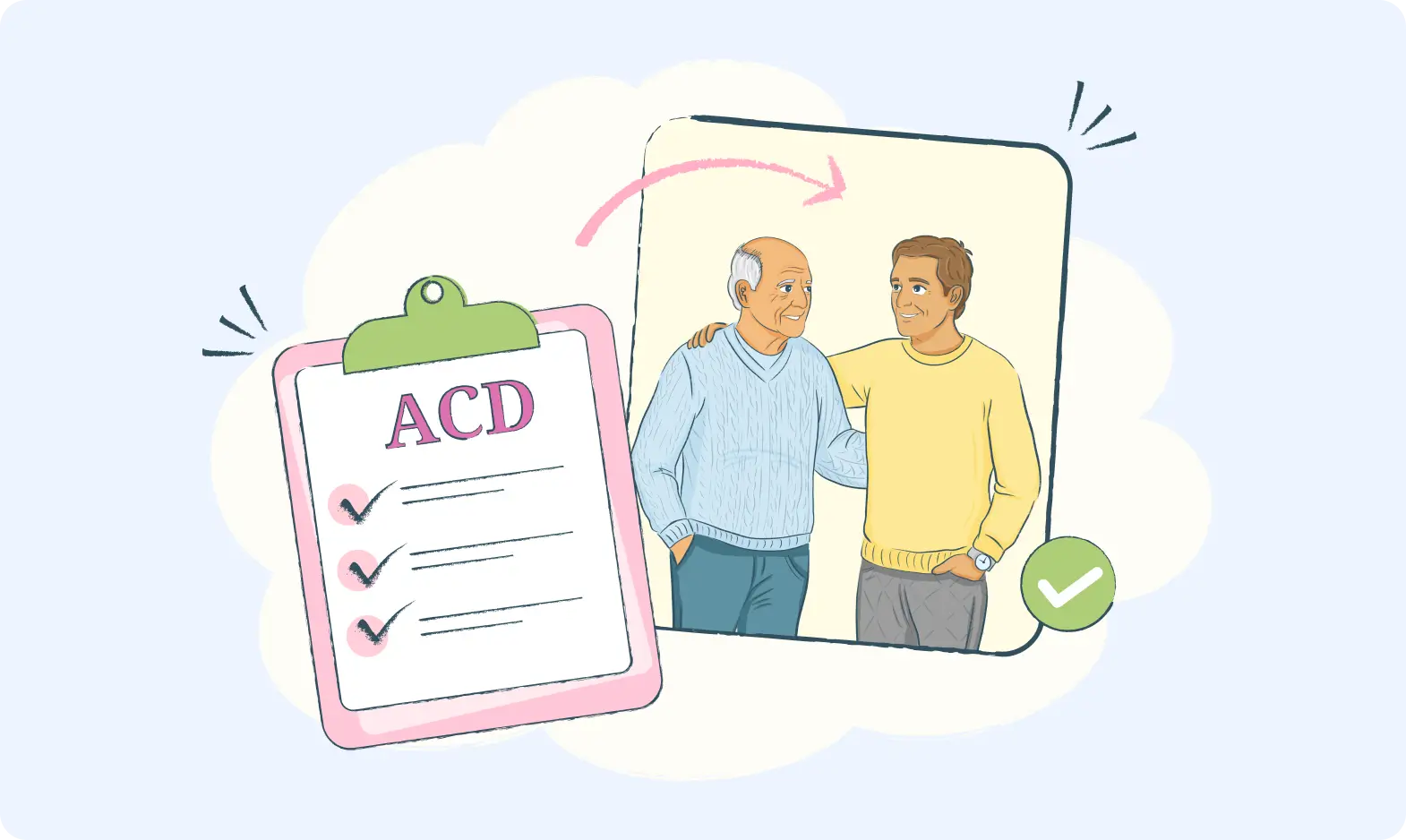
An advance care directive is a document that records your wishes for your future health care, so that if there ever comes a day when you can’t make or communicate decisions for yourself, the people around you know what matters to you.
It can spell out the care and treatments you would want, the ones you’d rather refuse, and the values that should guide any decision made on your behalf. Think of it less as a legal hurdle and more as a letter to the people who’ll one day need to step in – telling them, in your own words, this is what a good day looks like to me, and this is what I’d want you to do.
Advance Care Directive vs Advance Care Plan: What’s the Difference?
These two get used interchangeably, but they’re not quite the same:
- Advance care planning is the process: The thinking, and the conversations with your family and doctor about what you’d want.
- An advance care directive is the document: Where you write those wishes down, often on a form recognised by your state or territory.
The planning is the heart of it. The directive is what makes your wishes clear, and harder to overlook.
Are Advance Care Directives Legally Binding?
In most of Australia, yes – a valid advance care directive is legally binding, and health professionals must follow it.
But here’s the honest nuance: The rules differ depending on where you live. In some states and territories, the part that’s strictly binding is a refusal of treatment – your wishes about the care you’d want may guide your medical team rather than legally bind them. In South Australia, for example, only instructions to refuse or withhold treatment are legally binding.
That’s not a reason to skip it. Even where a directive isn’t strictly binding, it gives your family and doctors a clear, documented sense of your wishes, which can spare them an agonising guess at the hardest possible moment.
It Works A Little Differently In Every State And Territory
This is the part that trips people up, so it’s worth saying plainly: the forms and the laws are different in each state and territory. Every state and territory, except New South Wales, has its own statutory (legislated) form, and even the name for the person you appoint to speak for you changes from place to place.
So the right form for someone in Victoria isn’t the right form for someone in Queensland. The simplest way through is to use your own state or territory’s official documents, and Advance Care Planning Australia has them all, set out state by state.
How to Make An Advance Care Directive
The good news: You don’t need a lawyer, and you don’t need to do it all in one sitting.
- Think about what matters to you: What does living well mean to you? What would you want, or not want, if you became seriously unwell?
- Talk it through: Share your thinking with the people closest to you, and with your GP – these conversations are the most important part.
- Choose someone to speak for you: We’ll delve into this point in the next section.
- Write it down: On your state or territory’s form.
- Sign and date it: You’ll need to have decision-making capacity at the time; your substitute decision-maker and your doctor can sign it too.
- Share copies: With your GP, your family, your substitute decision-maker, your hospital, and your aged care provider, so it’s there when it’s needed, not sitting in a drawer.
Choosing Someone to Speak for You
Part of planning ahead is naming a substitute decision-maker, which is the person who can make health decisions for you if you can’t (the exact title may vary by state: enduring guardian, medical treatment decision maker, and so on).
It’s strongly recommended to only choose someone whom you trust completely – someone who knows your wishes and will actually honour them (even if they’d choose differently for themselves). This is also, quietly, a safeguard: naming the right person, while you’re well, helps keep your future in steady, trusted hands. It’s the very thing we touched on in last week’s piece – staying in control of your own care.
When Should You Start? Sooner Is Kinder
There’s a gentle myth that advance care planning is something you do once you’re unwell, or much older. In truth, the best time is while you’re well and thinking clearly, because a directive only counts if it’s made while you have decision-making capacity.
Doing it early isn’t morbid. It’s one of the kindest things you can do for the people you love – lifting the weight of guessing off their shoulders, so that if a hard day ever comes, they can act with confidence instead of doubt.
Where to Get Help
You don’t have to work this out alone, the following resources are readily available to you:
- National Advance Care Planning Support Service: Simply call 1300 208 582 (9am–5pm AEST, Mon–Fri) to seek free advice to guide you through the process. You can also email acpa@advancecareplanning.org.au if you’d prefer to write it out.
- Advance Care Planning Australia: This government website provides the specific forms and/or rules needed for each state and/or territory.
- Your GP: A natural place to start the conversation and lodge your directive.
- And if you’d like the bigger picture, our guide to living wills and advance care planning walks through how this fits alongside your other decisions – as does our piece on the end-of-life pathway under Support at Home.
A Final, Gentle Word
An advance care directive isn’t about dwelling on the worst. It’s about making sure that, whatever comes, your voice stays in the room. That the people who love you aren’t left guessing. And that the care you receive reflects the person you’ve always been – that’s not a sad thing to organise, it’s a loving one.