
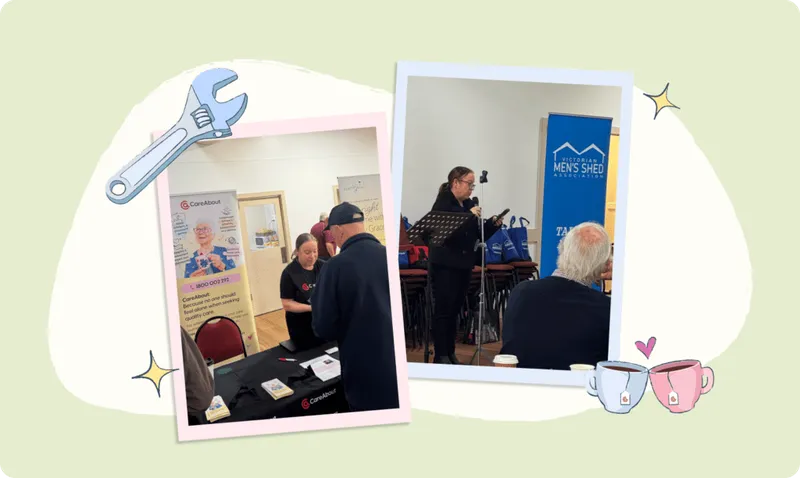
Last Friday, we packed up and headed to Berwick. CareAbout was there for the SE Southern Metro Roadshow at the local Men’s Shed – a room full of blokes, a kettle that never stopped boiling, and the kind of honest, unhurried conversation you don’t get nearly enough of.
One of the leaders, John Toomey, a global thought leader on mental wellbeing and resilience, provided a powerful speech at this event. And he said something that stayed with us long after the tea had gone cold:
‘The opposite of addiction is connection.’
It’s a line borrowed from journalist Johann Hari, and it cuts right to the heart of why a place like a Men’s Shed exists. Because so much of what quietly erodes men’s mental health – the isolation, the bottling-up, the ‘she’ll be right’ that masks something heavier, comes down to disconnection. And the way back isn’t complicated. It’s connection.
June is Men’s Health Month, and the numbers behind it are sobering. In Australia, men account for around three in four suicides, yet they’re far less likely than women to ever reach out for help. That gap – between how much men are struggling and how rarely they say so, is exactly what we want to talk about.
So here are five renowned, well-evidenced ways to strengthen men’s mental health. Not quick fixes. Just things that genuinely work – for blokes of every age, including the older men and male carers we walk alongside every day.
1. Connection: The Quiet Antidote for Men’s Mental Health
If there’s one thing the research keeps confirming, it’s this – connection is protective. Strong social ties are linked to lower rates of depression, better physical health, and longer lives.
For men, this matters in a particular way. Friendships often fade after retirement, after a partner passes, after the structure of work disappears. The phone stops ringing. The days get quiet. And loneliness, left alone, has a way of becoming something heavier.
This is the genius of the Men’s Shed movement, and why John Toomey’s line landed so hard. Sheds give men a reason to turn up, a project to lean over, and someone to talk to while they do it. The conversation happens sideways, shoulder to shoulder, which is often how men open up best.
You don’t need a shed to start, though. A standing coffee with a mate. A walking group. A weekly phone call. Connection doesn’t have to be grand to be powerful, it just has to be regular. We’ve written more about what genuinely helps loneliness in later life if this one hits close to home.
2. Move Your Body, Steady Your Mind
It sounds almost too simple, but the evidence is overwhelming – regular physical activity is one of the most reliable things you can do for men’s mental health. Movement releases the chemistry that lifts mood, eases anxiety, and helps you sleep. For some men, exercise is as effective as medication for mild to moderate depression.
And it doesn’t mean punishing yourself at a gym. A daily walk. Gardening. A swim. A hit of golf with a friend (connection and movement – two for the price of one). The goal isn’t fitness for its own sake; it’s the steadiness that comes from moving your body most days.
For older men especially, gentle, consistent movement protects both body and mind. If you’re after small, doable starting points, our five-minute habits for ageing well is a good place to begin.
3. Say It Out Loud: The Strength in Asking for Help
Here’s a hard truth about men’s mental health that Men’s Health Month exists to challenge – too many men are raised to believe that struggling in silence is strength. It isn’t. It never was.
Naming what you’re feeling, out loud, to someone you trust is one of the bravest, most effective things a man can do for his mental health. That might be a GP, a counsellor, a helpline, or simply a friend who’ll really listen. Talking doesn’t make you weak. It makes you human – and it’s often the first step that changes everything.
If you or someone you love is doing it tough, Beyond Blue and Lifeline (13 11 14) are there around the clock, no appointment needed. And for the men quietly caring for a partner or parent, a role that carries its own hidden weight, our piece on maintaining good mental health is written with you in mind.
4. Read Good Books: Quiet Company for a Restless Mind
Reading is one of the most underrated tools for men’s mental health. It lowers stress, sharpens focus, and, perhaps most importantly, it makes us feel less alone. A good book is company. It tells you that someone, somewhere, has felt what you’re feeling and found words for it.
Which brings us back to Berwick. The book John Toomey pressed into the conversation that day was Chasing the Scream by Johann Hari, a hard but rewarding read, in his words. It’s where that line, ‘the opposite of addiction is not sobriety, it’s connection,’ comes from. Hari travelled the world to understand what really drives addiction, and what he found was less about the substance and more about the absence of connection in a person’s life.
It’s a fitting recommendation, because the book is the message. Read it, and you come away understanding, in your bones, why turning up to the shed, calling the mate, or simply not going it alone matters so much.
So pick up a book this month. It doesn’t have to be a heavy one. But if you’re up for it, Chasing the Scream is a powerful place to start.
5. Find Purpose and Routine: A Reason to Get Up
The Japanese have a word, ‘ikigai,’ for the reason you get out of bed in the morning. It’s a small idea with a big effect on men’s mental health. Purpose gives the days shape, and routine gives them rhythm. Both are quietly protective against the drift that can pull men down, particularly after retirement.
Purpose can look like anything – volunteering, mentoring, a hobby you’ve let slide, a project at the shed, looking after the grandkids on a Tuesday. The point isn’t to be busy. It’s to have something that’s yours, something that gives the week meaning. We explored this beautifully through David Attenborough’s approach to ageing well, if you’d like a little inspiration.
The Real Takeaway
If there’s a thread running through all five of these, it’s the one John Toomey gave us in that warm, tea-filled room in Berwick.
Connection.
A book that reminds you you’re not alone. A walk with a friend. The courage to say ‘I’m not okay’ out loud. A shed full of blokes and a kettle on the boil. When it comes to men’s mental health, they’re all the same medicine, really – the quiet, powerful work of staying connected.
This Men’s Health Month, that’s our gentle nudge. Reach out to the men in your life. And if you’re a man reading this who’s been doing it tough on your own – you don’t have to. The opposite of addiction, after all, is connection. And it’s never too late to find your way back to it.
How We CareAbout You
We understand how having an insufficient quality of care can negatively impact your mental health.
We’re here to CareAbout you. At CareAbout, we only work with vetted, high-quality providers who meet our thorough standards for reputation, transparency, flexibility, and compassion. Along your care journey to finding the right provider – we understand how
Our CareAbout team will help you to:
- Ask the right questions
- Compare providers side by side
- Understand where your money’s going (without any fancy terms or footnotes)
- Switch with no service gaps or awkward calls
We’re here to CareAbout you—and at no cost.