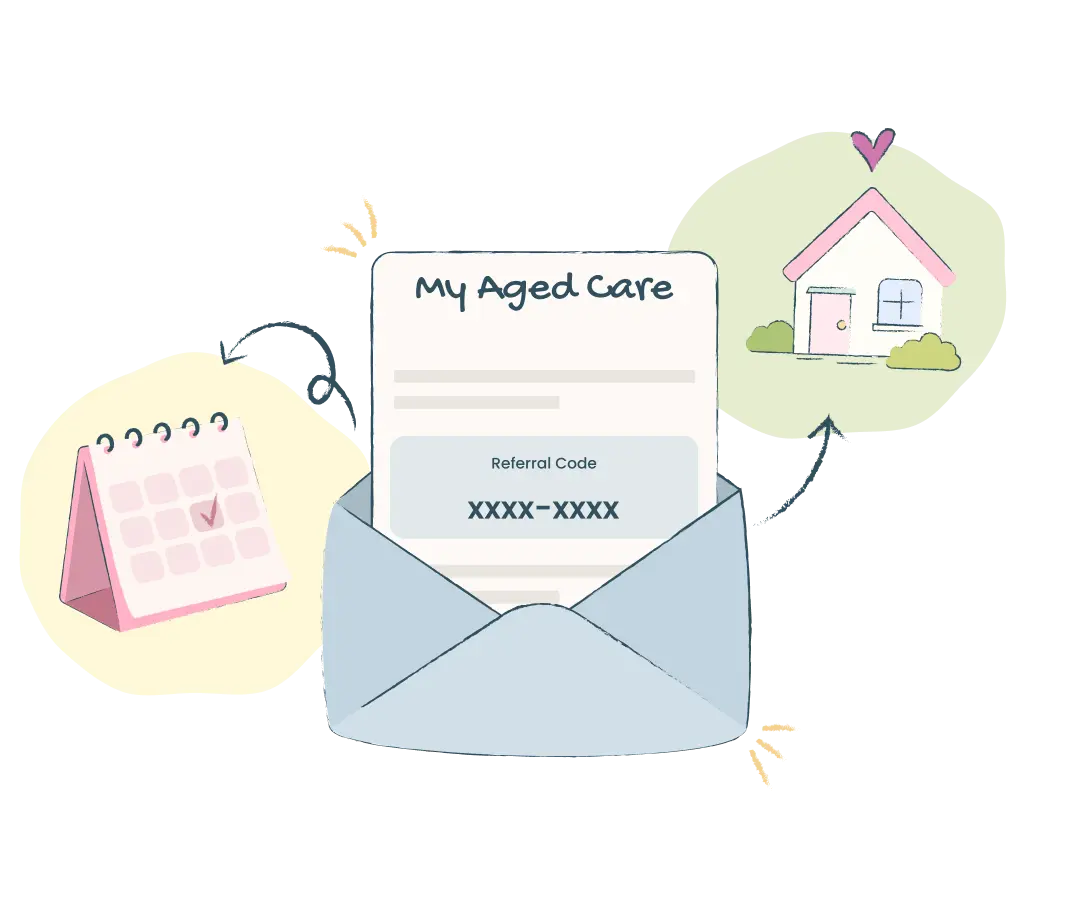
You've got a letter, or a code, or a screen full of My Aged Care words, and you're not entirely sure what any of it means. What's a referral code? Do you use it, hand it over, wait for something else to happen first? And can Mum, or your wife, or you actually get some cleaning sorted now, or is there another step you've missed?
You're not being slow. This system was built with its own language, and nobody sat any of us down to explain it. So let's go through aged care referral codes properly: what they are, the different kinds you might see, and what to do with the one in front of you.
1. What an aged care referral code actually is
After an aged care assessment, My Aged Care doesn't just tell you what you're eligible for. It gives you a way to act on it. That's what a referral code is: a short code, a string of letters and numbers, that you pass to a provider so they can look up what's been approved for you and start arranging it.
Think of it as a key. It doesn't do anything sitting in a drawer. But hand it to the right provider, and it unlocks the specific support your assessment agreed you should have.

Two practical things worth knowing straight away. You get one code for each service you've been approved for, not one code overall — so if you were approved for cleaning and transport, that's two codes. And If you've lost your code, it's in your My Aged Care Online Account, listed in your support plan. You don't need a new assessment to get it back.
2. The different types of referral codes
This is the question that comes up most on this topic, and it's a fair one, because the codes aren't all the same.
The useful way to think about it is that a code points to a program. Which program you've been approved for is what determines everything else: whether you can start now, whether there's a wait, and whether an expiry date applies.
A CHSP code — entry-level services
The Commonwealth Home Support Program (CHSP) is the entry-level program. It covers things like domestic help, transport, meals, home maintenance, social support, and basic personal care and nursing.
If your code is for domestic assistance, this is almost certainly the program you're in. The code tells a provider: this person has been approved for help with cleaning and household tasks. You give it to a provider registered to deliver that service, and they take it from there.
CHSP is for people aged 65 and over, or 50 and over if you're Aboriginal or Torres Strait Islander, or 50 and over if you're homeless or at risk of homelessness.
A Support at Home code — ongoing funded support
Support at Home is the current home care program, which replaced Home Care Packages and Short-Term Restorative Care from 1 November 2025. It's for people whose needs are more complex, assessed through a fuller conversation — usually an aged care assessor visiting you at home.
Here, there is only one code for multiple services in your ongoing budget. This code still connects you to a provider, but there's more behind it: an approved ongoing budget, a funding allocation that has to come through, and a service agreement to sign.
A permanent residential care code — when you need to move into a residential aged care home
If the assessment approved you or your family member for permanent residential aged care, the code attached to that approval is what you hand to an aged care home.
This one behaves differently to a Support at Home code, and the difference is worth understanding. There's no funding allocation queue sitting behind it. You aren't waiting for money to be released before anything can happen — you approach homes directly, and what determines your timing is whether a home has a room and can meet the needs in your approval.
A respite code — a short stay, or a break for a carer
Respite is care for a defined period rather than an ongoing arrangement. It exists to give the person a change of setting, or their carer a genuine break, and a respite approval comes with its own code.
The important thing here is that respite isn't one thing. Residential respite is a short stay in an aged care home, and that's what a respite code covers. But respite also comes through the other two programs: in-home respite is an independence service under Support at Home, and CHSP funds centre-based day respite and cottage respite. Same word, three different pathways — so the question is always which program your approval sits in.
We've set out how aged care and respite codes work in practice in section 4.
If you genuinely can't tell which one you're holding, that's not a failing on your part. Your Notice of Decision letter names the program and the services approved. Or call My Aged Care on 1800 200 422 and ask them to read out what the code covers. It's their job to tell you.
One thing that applies to every type of code: a referral code is designed so you can shop around. You can take it to several providers and talk to all of them before you commit to one. It isn't a binding choice at the moment it's issued.
3. Can services start now, or do you wait for funding?
This is the one that keeps people stuck: you have a code for domestic assistance in front of you, and you can't tell whether you can act on it or whether there's a funding approval still to come.
The answer genuinely depends on which program your code belongs to.
If it's a CHSP code: no funding wait
There's no individual budget being calculated in the background. CHSP providers are funded directly by the government to deliver subsidised services, so there is no pot of money you're waiting on. You find a provider, give them the code, and arrange the cleaning.
Which means that if you've been sitting tight waiting for a second letter or an approval to land, you may not need to be. You can start looking for a provider today.
What can still hold things up is availability, not funding. Providers don't always have capacity for a new client immediately, some will put you on a waitlist, and people with the highest assessed need are offered services first. So it's worth contacting more than one provider rather than waiting on the first.
If it's a Support at Home code: yes, and it's worth knowing how long
Ongoing Support at Home funding is released through the Support at Home Priority System, based on the priority category in your assessment outcome letter and the date you were approved.
The estimated wait times, as at 30 June 2026, were:
- Urgent priority: within 1 month
- High priority: around 1 month
- Medium priority: 5 to 6 months
- Standard priority: 7 to 8 months
Two things soften that. If your wait runs longer than expected, you may be offered interim funding, 60% of your approved budget released early so the most critical services can start, with the rest following when funding becomes available. And funding is allocated separately for each service, so you don't have to wait for everything before starting anything. If your home modifications funding lands before your ongoing services funding, you can begin with the home modifications.
Either way, you can start talking to providers immediately. Nothing stops you comparing, asking questions and choosing someone while you wait, so you're ready to move the day your funding arrives.
If it's an aged care or respite code: no Priority System queue
Neither permanent residential care nor residential respite runs through the Support at Home Priority System, so there's no funding allocation to wait on. What you're working with instead is availability: whether a home has a place, and whether it suits. For respite in particular, popular homes book out over school holidays and around Christmas, so it's worth booking well ahead if your dates are flexible.
4. Aged care and respite codes: how those two work
These two get less airtime than home care, so here's the detail that actually matters when you're holding one.
A permanent residential care code
Once you're approved, you contact homes yourself — the approval doesn't place you anywhere. Take the code to a few, look at them properly, and ask what they can accommodate.
Codes do need reactivating in some situations. If your code has already been accepted by another provider, or a service you'd started has since stopped, or a time-limited approval has lapsed, the code won't simply work again. You can reactivate it through your My Aged Care Online Account, or by calling 1800 200 422.
On cost, one change from 1 November 2025 is worth knowing before you sign anything: a refundable accommodation deposit is no longer fully refundable. Providers now retain 2% of it a year, for up to five years. If you're weighing a lump sum against a daily payment, that changes the arithmetic, and it's worth getting advice specific to your circumstances before committing.
A residential respite code
Respite is capped in days rather than dollars. You're entitled to 63 days of respite care in a financial year, and that can be extended by up to another 21 days if an aged care assessor approves it — 84 days at most. The extension has to be requested before your entitled days run out, so flag it early rather than after the fact.
On fees, three things come up repeatedly:
- A basic daily fee. Every resident can be asked to pay this. It covers meals, cleaning, laundry and heating, and the maximum is 85% of the single basic Age Pension. It moves each March and September with the pension.
- A booking fee, sometimes. A home may ask for one to hold your dates, and it's the only fee that can be charged before you go in. It's capped at whichever is lower of one week's respite fee or 25% of the fee for the booked period, and once you enter it comes off your daily fees rather than sitting on top. You get it back in full if you cancel more than seven days before your entry date, or if you go into hospital before then.
- No accommodation costs. A home cannot charge you for accommodation for a respite stay. The government pays them a respite accommodation supplement instead.
Two more things that surprise people. In a genuine emergency, someone can enter residential respite before the approval is finalised — the paperwork follows, with an application going to the assessment organisation within five business days. And the leave rules that apply to permanent residential care don't apply to respite: if the person goes into hospital mid-stay, those days still come off the respite balance. If keeping the place open matters, say so, because the home will hold it while the booking stands.
5. What happens if you go past the deadline
If a deadline has passed and you're worried you've missed your chance, here's the actual rule, and it's worth knowing precisely, because it's more specific than most people are told.
Once your Support at Home funding is allocated, you have 56 days from the date of that letter to enter into a service agreement with your chosen provider and start services. If you need longer to find someone suitable, you can call My Aged Care and ask for a 28-day extension, which takes you to 84 days in total.
If the window closes without a service agreement in place, your funding is withdrawn and allocated to the next person in the Support at Home Priority System.
That's the part worth taking seriously. It isn't a paperwork slip. It's the allocation going back into the queue. You can re-join the Priority System by calling My Aged Care, but you re-join it; you don't pick up where you left off.
So the practical move, in order: if you're anywhere near the deadline and haven't signed with a provider, ring My Aged Care on 1800 200 422 and ask for the extension before the window shuts. If it's already passed, ring them anyway and ask what's needed to get back into the system. A passed deadline is recoverable. It's just more expensive in time than the extension would have been.
Worth noting: this 56-day clock is a Support at Home rule only. A CHSP code doesn't carry it, because there's no individual funding allocation attached to it. Neither does an aged care or respite code, because a respite approval is limited in days of care rather than by a take-up deadline. If your code is for domestic assistance under CHSP, this deadline almost certainly isn't the one you're worried about, but call and confirm rather than assume.
6. How Support at Home works when it's all new to you
If this is your first time near any of it, the question underneath everything is usually: how does this actually work for someone who's never done it before?
Here's the shape of it, without the jargon.
- You register and get assessed. It starts with My Aged Care: a call, then an assessment. For lighter supports that can be a shorter conversation; for ongoing support it's usually an aged care assessor visiting your home to talk through how things are going. They're not testing anyone. They're listening.
- You're approved for something specific. Either CHSP entry-level services, or an ongoing budget under Support at Home. This is where your referral code comes from, and your Notice of Decision letter sets out what was approved and why.
- You wait for funding, if it's Support at Home. Your letter will give you a priority category. Use the wait as preparation time rather than dead time. Compare providers, ask about costs, and have someone chosen before the funding lands.
- You choose a provider. You're not assigned one. You get to pick who delivers your care, and you pick one provider to deliver all of your services.
- You give the provider your code and services begin. For a CHSP service, that can be quick. For Support at Home, you'll sign a service agreement, and remember the 56-day clock starts from your funding letter, not from when you get around to it.
Two levers most people don't know they have. If you want to change providers later, you need to reactivate your referral code, through your My Aged Care Online Account or by calling 1800 200 422. The code doesn't simply transfer.
And if you're organising ahead rather than in crisis, you can ask My Aged Care to set your status to "not seeking services". That stops funding being allocated before you're ready to use it, which matters, because once it's allocated the 56-day clock runs whether you're prepared or not. You can switch back whenever you like.
7. Getting cleaning sorted: the practical bit
A lot of what people actually want from all this is simple and human: some help keeping the house clean, at a cost that works. So let's talk about that directly.
If you or your partner has a referral code for domestic assistance, the cleaning is already approved. The task now is choosing the right provider to deliver it. "Right" here doesn't mean the biggest name or the one at the top of a list. It means the provider whose availability, approach and pricing fit your place and your week.
On cost: under CHSP you're expected to contribute towards the cost of your services if you can afford to. Each provider sets its own prices, and My Aged Care's own guidance is that simple services like house cleaning and meals "might cost a few dollars", while more complex supports cost considerably more. We won't quote you a figure, because it varies by provider and by your circumstances, and a made-up number helps no one. What we can do is help you understand what your contribution is likely to look like before you commit to anything.
A quick checklist before you choose a provider
- Confirm your referral code and exactly which service it covers
- Check whether your code is CHSP or Support at Home, because it changes whether you're waiting on funding
- Ask what your contribution would be, and whether rates differ on weekends
- Ask about availability: how soon they can start, whether there's a waitlist, and how flexible the roster is
- Check they're registered to deliver the specific service on your code
- Ask whether they deliver the service themselves or subcontract it
Get those answers and you've cut through most of the confusion in one conversation.
8. You're closer than it feels
If you've read this far, notice something: the questions you started with mostly have short answers. The code is a key, and you get one per approved service. If it's a CHSP code for domestic assistance, you can proceed now, because availability is the only thing in your way. If it's Support at Home, there's a wait, and it's published, so you can plan around it. If a deadline has passed, it's 56 days you were working to, an extension exists, and re-joining is possible.
The system made this harder than it needed to be. You didn't. And you don't have to untangle it on your own.
We can help you make sense of the code you're holding, work out what it covers, and match you one-to-one with a provider who's right for your home, including sorting something as simple and welcome as regular cleaning. It's free to you, and there's no pressure to decide anything today.