David Attenborough at 100: Ikigai, Nature and the Art of Ageing Well
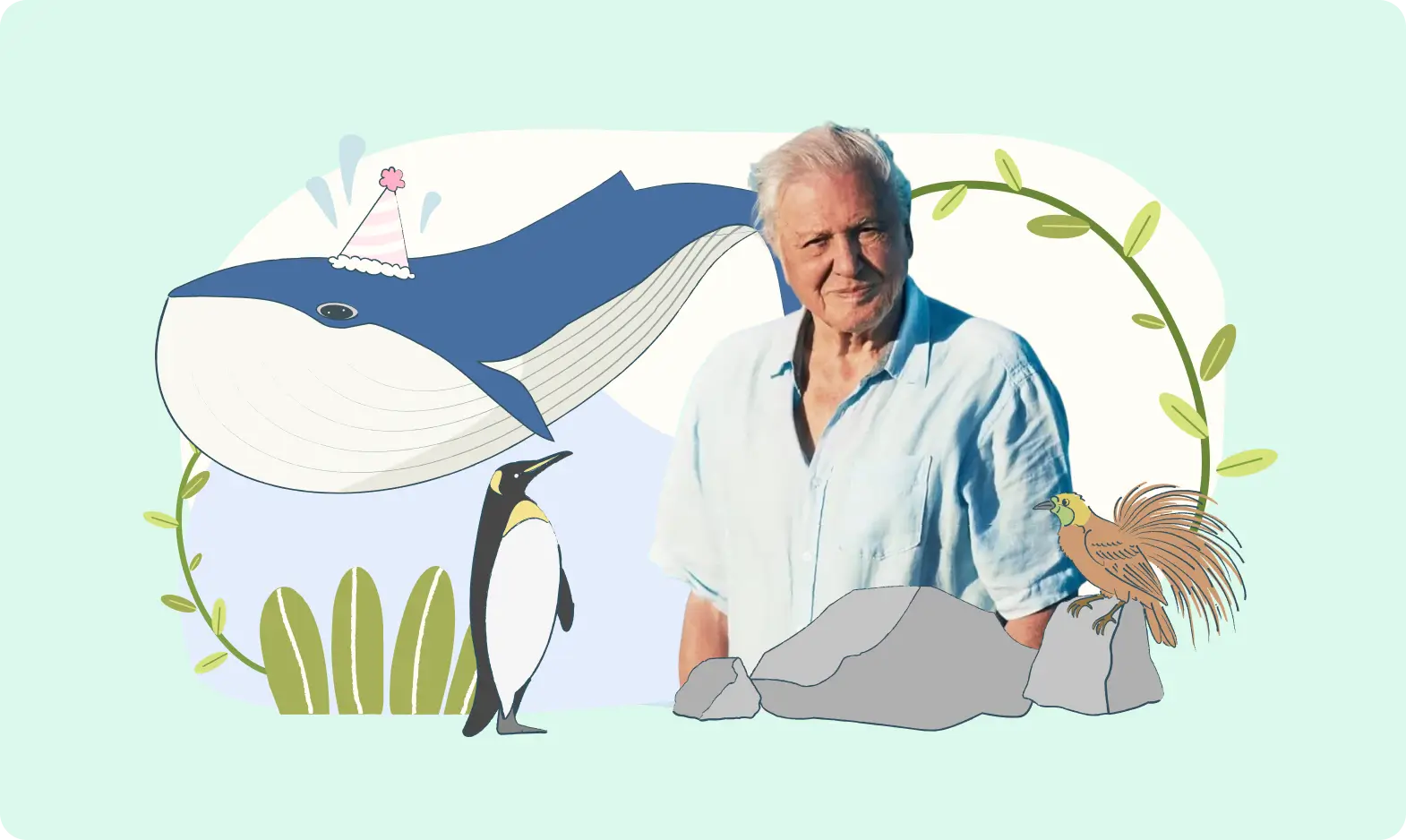
You know the voice before you know the face. The gentle, slightly hushed, slightly conspiratorial murmur – the same voice that has somehow narrated the migration of wildebeest, the courtship of birds of paradise, and the fragile breathing of a sleeping orangutan to half the planet.
On May 8 this year, that voice, the one-and-only Sir David Attenborough – broadcaster, naturalist, gentle revolutionary, turned 100! And he is, almost incredibly, still working.
In celebration of this remarkable icon, who has allowed us to see so much of this astonishing world through a lens only he could provide, we take this time to pause and reflect: What is it about this particular life that has stayed quietly luminous for so long? Because this isn’t just a man who has lived for a very long time. Sir David Attenborough’s a remarkable individual who’s turned his passion into his life-long mission, even at an age that most people would’ve simply hung up the binoculars by.
When we look at Sir David Attenborough’s life, we see his life as a quiet masterclass in healthy ageing.
There’s no green powder or “magic anti-ageing potion,” no biohacking or no strict regime. There is, instead, something very special that the Japanese have a word for: Ikigai. There’s the natural world, and then there’s the simplest, oldest secret to a long life: A reason to wake up tomorrow.
A Century of Curiosity
Born David Frederick Attenborough in Isleworth, London, on 8 May 1926. His brother Richard would go on to direct Gandhi, while his other brother, John, ran a Rolls-Royce factory. David collected fossils, salamanders and birds’ nests as a small boy, and never really stopped.
In 1952, Attenborough joined the BBC. He has never really stopped working there since. Zoo Quest. Life on Earth. The Living Planet. The Trials of Life. Blue Planet. Planet Earth. Frozen Planet. Africa. The Hunt. Dynasties. A Life on Our Planet. Each one a generation’s introduction to the wild.
He was knighted in 1985. He has been named, survey after survey, as the most trusted person in Britain. He has also, and this is the part that quietly matters here, kept narrating, writing, advocating and showing up well into his nineties.
What you notice, reading his interviews back across the decades, is that he doesn’t talk like a man who is “ageing well”. He talks like a man who is still, at every age, interested. Interested in the world. Interested in the people in it. Interested in what’s coming next.
That, more than anything else, may be the secret. Not the diet. Not the exercise plan. Just the curiosity, kept in working order until the very end; a fulfilling life lived.
‘Ikigai,’ The Japanese Word for What David Attenborough’s Achieved
There’s no single English word for what David Attenborough seems to have. But there is a Japanese one.
Ikigai (pronounced ee-key-guy) is a Japanese concept that doesn’t translate neatly. The closest approximation is the reason you get up in the morning. Not a job title. Not a goal. A quieter, deeper sense of purpose that gives a life its shape; that innate passion; that natural drive that motivates you to seek more from life and in turn, to feel fulfilled and content with your presence here on Earth.
Researchers and travel writers have spent years studying it in Okinawa, one of the world’s five “Blue Zones,” the regions on Earth where people most consistently live past 100. Okinawa centenarians, almost without exception, can name their ikigai. For one woman it might be her grandchildren. For another, her vegetable garden. For another, the practice of weaving, or fishing, or teaching the young.
What researchers have found is that having an ikigai correlates with longer life, better cognitive function in old age, lower rates of cardiovascular disease, and a lower risk of dementia. Purpose, it turns out, is one of the most powerful health interventions we have – and one we hand out the least.
You don’t need to move to Okinawa. You don’t need to translate the word. You just need to know what makes you feel alive.
If you’d like a quiet starting point, we’ve put together seven self-care books to help you age with vitality and purpose – and the very first on the list is Ikigai: The Japanese Secret to a Long and Happy Life. It’s a slim, lovely read. The kind of book your aunt will press into your hand.
David Attenborough, on this measure, is unmistakably Okinawan in spirit. He just narrates in English.
Nature as Medicine: The Truth Behind this Adage
Here’s something we sometimes forget, especially in an age of screens and supplements: Humans evolved outside.
For roughly 300,000 years, we lived in close contact with the natural world – with birdsong, with trees, with seasonal light, with the moods of weather. The biologist E.O. Wilson coined a name for our innate human tendency to seek connection with nature and other living things: Biophilia, which translates as “the love of life,” of the living.
Modern research has caught up to this intuition. Spending even short amounts of time in green space has been shown to lower cortisol (the stress hormone), reduce blood pressure, improve sleep, lift mood and slow the cognitive decline associated with ageing.
The Japanese also have a specific practice for this. They call it shinrin-yoku, or “forest bathing”: The deliberate, slow, sensory immersion in a forest, with no aim beyond simply being there. Studies on shinrin-yoku have shown measurable improvements in immune function and mood after as little as twenty minutes among trees.
What all of this tells us, is that connection to nature is not a luxury for the retired and unhurried. It is a basic biological need, like food and sleep – and one we have systematically engineered out of modern life.
For older Australians, this matters more than most. As we age, our bodies become more sensitive to stress, more vulnerable to inflammation, more affected by isolation. Time outside, even modest amounts, does work what no supplement can.
Whether this means a short walk along the beach, half an hour in the garden, watching the lorikeets at the bird feeder over breakfast, or just sitting on the verandah at dusk doing nothing. And all of these are more than the “nice if you can” variety, they’re simply, medicine.
David Attenborough has spent a hundred years arguing, gently and persistently, that the natural world is the most important thing we have. Watching his life, you start to suspect he was, in fact, prescribing this nature-as-medicine to himself the whole time.
Five Quiet Lessons From a Hundred Years Outside
If we wanted to distil a century of Attenborough’s life into a few lines, they might read something like this.
1. Stay curious.
Curiosity isn’t a personality trait. It’s a practice. Read about something you don’t understand. Ask someone half your age what they’re working on. Learn the names of the birds in your own backyard. The more you keep wondering, the more your brain stays elastic.
2. Keep moving – at whatever pace.
You don’t need to run a marathon. You need to walk, garden, swim, dance, climb the back step, carry the groceries, get out of the chair. Movement protects your bones, your muscles, your heart and, more than most realise, your brain. We’ve written about why hydrotherapy works when everything else hurts, for older Australians whose joints have started to grumble.
3. Find your personal why.
Whether it’s grandchildren, a tomato patch, a community choir, a book group, a beekeeping habit, a volunteer shift at the local library – find the thing that makes Tuesday morning feel useful. Your why is not a luxury. It is the floor under your feet.
4. Make awe a daily practice.
Awe, the feeling of being small in front of something big, has been shown in research to reduce inflammation, lower blood pressure and protect against depression. The world is full of it; a sunrise, a wave, a pelican, a grandchild’s face when they discover something for the first time. Awe is free, daily, and chronically under-prescribed.
5. Stay connected…
…to people, to places, to memories, and of course, the natural world. Loneliness in later life has a measurable effect on health. The antidote isn’t always more activity. Sometimes it’s just one good conversation, one shared meal, one walk in the open air, with someone who knows you (or even someone you’re yet to meet). We discuss the importance of this in further detail in our article on navigating the emotional challenges of ageing.
Of course, these are not Attenborough’s words. They are simply the pattern of his life, laid out like a map.
How to Find Your Own Ikigai
If the idea of Ikigai appeals, and you’d like a gentle place to start, here are four questions to reflect on:
- What do you love? Not what you should love. Not what you used to love. What still makes time disappear?
- What are you good at? Skills you’ve earned, sometimes without noticing – listening, gardening, problem-solving, baking, calming a child, fixing things?
- What does the world need most? At any scale – whether that’s observing your street, your grandchildren, your local community, or simply a friend who’s struggling and in need of help.
- What feels meaningful to you? Not “paid”, necessarily, instead this could be to travel more, do volunteer work, craft, take on a caring role, or start a project that has nothing to do with money.
Where these four overlap and interconnect, even gently, is where your ikigai lives.
You don’t have to land on a single answer. You don’t have to dramatically reinvent your life. The point of ikigai is not to add another task to a busy week. The point is to notice the parts of your life that already feel alive, and quietly give them more room.
Our seven self-care reads include the original Ikigai book by Héctor García and Francesc Miralles – a short, warm read that pairs beautifully with a cup of tea.
Staying Connected to Nature in Australia
If Sir David’s life has anything specific to teach Australians, it’s that we live in one of the most extraordinary natural environments on the planet — and most of us neglect making the time to properly explore it.
A few gentle, accessible ways to bring more nature into the rhythm of your week:
- Walk somewhere green: A coastal track, a botanic garden, a street lined with old trees (even fifteen minutes counts).
- Watch the birds: Australia has some of the most photogenic birdlife in the world. A simple feeder or bird-bath in the garden will attract honeyeaters, rosellas, kookaburras, magpies (the list goes on) – sometimes within days. BirdLife Australia is a beautiful, free resource for identifying who’s visiting.
- Garden: Even a few pots on a balcony, tomatoes, herbs, or native flowers. The act of tending a living thing, is in itself, a pure form of medicine.
- Become a citizen scientist. Apps like iNaturalist let you photograph and identify the wildlife in your own backyard, contributing real observations to real science. Sir David himself has championed citizen science in his later years.
- For those with mobility limits, nature comes inside too. A window seat facing a tree. House plants. A bird feeder near the window. A nature documentary in the evening – perhaps narrated, gently, by a familiar voice.
Connection to nature isn’t measured in kilometres, it’s measured in attention.
One Hundred Candles
Somewhere in England, a man will sit down to a quiet celebration of his hundredth birthday. He will be, at that moment, exactly what he has always been: A child of wonder – a small boy in the garden, looking under a stone.
There is no real way to say “Happy Birthday” to a stranger of his stature. But perhaps the most fitting tribute is the most personal one. So, we encourage you to look at something living today (or tomorrow); a tree, a garden bed, the sky (whatever it might be) and simply watch this for thirty seconds – then, you’ll realise how small we all are in front of nature, and that it’s this very humility, that ultimately inspires us all to embrace this miraculous planet earth.
Then quietly, gratefully, we each continue with our day. Because of course, Sir David Attenborough has never told us, directly, how to age well. But he has, in fact, shown us – and for officially a century now, what a curious, fulfilling and awe-filled life looks like.
Whether it’s a pair of binoculars, a walk in the morning air, a reason to get up in the morning, a creature worth watching, or more magnificent, a planet worth defending – these are not just the lessons of Sir David Attenborough, these are an invitation to each and every one of us, at any age, to experience life in all of its beauty.
Happy hundredth, Sir David. Thank you for showing us the way!