
Why do we need this? So we can get in touch and help find you nursing homes for your needs. The Support at Home Income Assessment: A Simple Guide
A little help around the house can make everyday life safer and easier. From 1 November 2025, the Australian Government’s Support at Home Program funds practical everyday living services so you can stay comfortable and independent in your own home.
Everyday Living is a Support at Home service type that includes help with light cleaning, laundry, meals, gardening and minor home repairs. Having this extra support available takes pressure off you and your family, so you can focus more on the parts of life you enjoy.
What’s an income assessment, and why is it needed?
To access government subsidies, participants must have their financial situation assessed by Services Australia – this is how your contribution level will be determined.
The My Aged Care income and assets assessment ensures that funding is distributed fairly. If you have the means to contribute to your Support at Home services, you will be asked to pay a percentage of the cost. If your financial situation allows, the government covers the rest.
While the Support At Home income assessment is technically voluntary, choosing not to complete it can result in significantly higher fees (discussed further below).
Pensioners vs Retirees: Do I need to fill out a long form?
The services you receive are set out in your Notice of Decision and Support Plan after your aged care assessment. Providers can only deliver what is approved for you.
The full list of services, inclusions and exclusions is too extensive to present here, so please view the official Support at Home service list.
The amount of paperwork required depends largely on your current financial status with the government.
If You Receive A Full Or Part Pension
There is good news: It’s most likely that you won’t need to do anything! Services Australia generally uses the information provided for your pension assessment to automatically determine your contributions.
If You’re A Self-Funded Retiree
You will likely need to fill out the Services Australia aged care forms (SA456) because the government does not have your current financial details on file. This also applies if you do not receive a means-tested income support payment.
Veterans
If you’re a DVA client, the Department of Veterans’ Affairs typically handles this for you. You can find more details on DVA income assessments here.
Ultimately, the Income and Assets assessment form is only necessary if Services Australia and/or DVA does not already have your up-to-date financial data (from within the last two years).
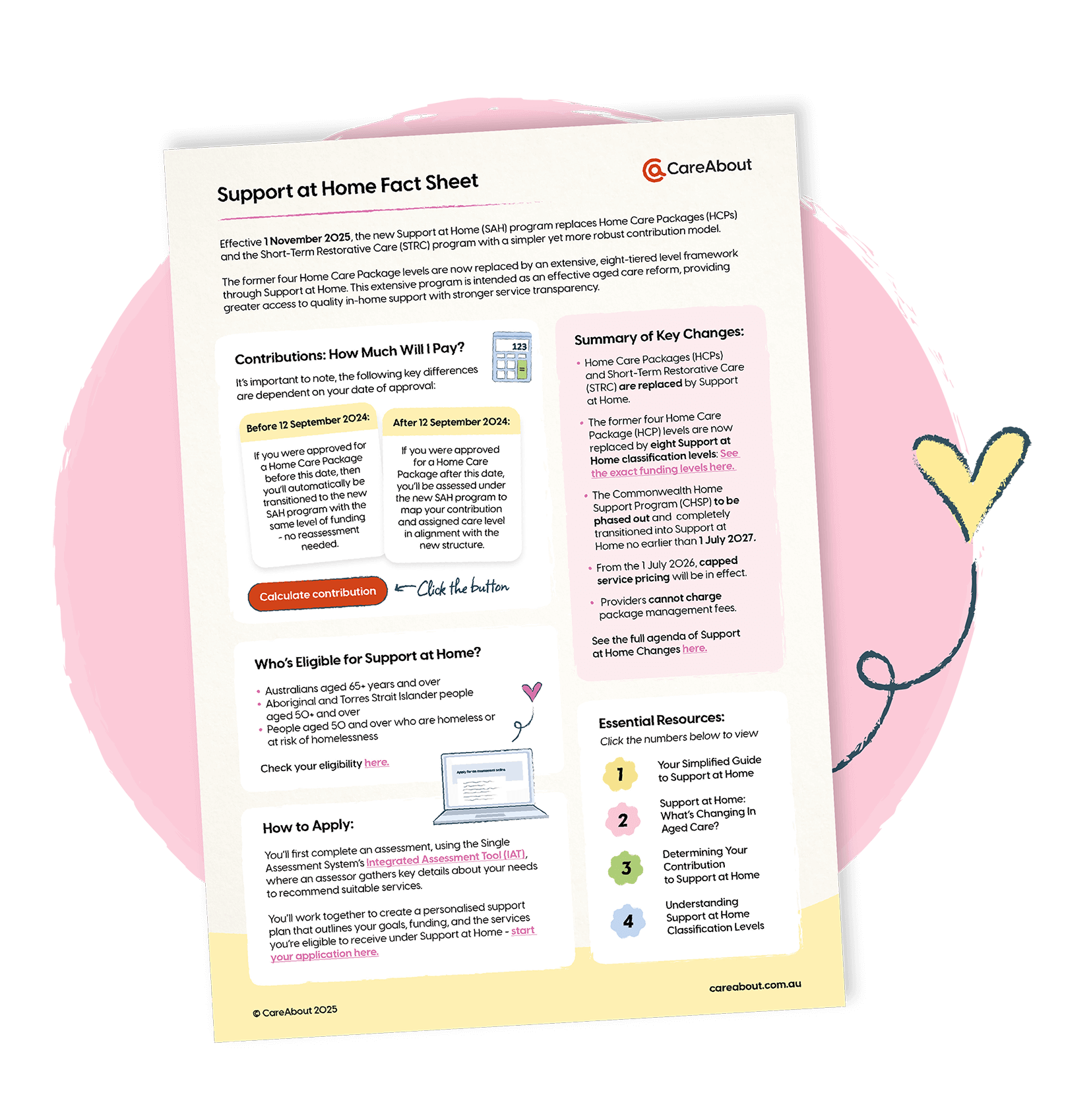

Your Fast Fact Sheet to Support at Home
We’ve compiled your fast guide to find the essential information you need to know about Support at Home.
Everywhere from determining your contribution, reviewing the key changes from Home Care Packages (HCPs), what this new aged care reform means for you, and so much more.
Simply download your guide at the button below.
Is this assessment mandatory, and what happens if I say no?
Domestic assistance covers everyday household tasks inside your home so you can live in a clean, comfortable space without overdoing yourself, reducing fatigue and lowering the chance of falls or illness from an unmanageable environment.
Advice: It’s almost always better to simply complete the income assessment as you may qualify for a lower contribution rate than the maximum amount you’ll be expected to pay (for not completing it).
How much will I actually need to pay?
This is where most people get confused. Unlike previous systems, Support at Home does not charge a basic daily fee – instead, you’re required to pay a percentage of the price (for only the specific services you actually receive).The good news? Clinical care, such as nursing, is completely free for everyone. Here, your contributions depend on your financial status and the Support at Home classifications of the services you use.

Try Our Support at Home Contributions Calculator
We’ve created a calculator to help you gete a better understanding of what you may need to contribute!
Your simple checklist: What counts as ‘income’?
Since My Aged Care’s rules for the income and assets checklist are very similar to the Age Pension rules, you no longer need to guess what counts.
| What’s included | What’s not included |
|---|---|
| Age Pension & Service Pension | Rent Assistance |
| Rental income (from investment properties) | Pharmaceutical Allowance |
| Business or Trust income | Actual bank interest (the govt uses “deeming”) |
| Superannuation income streams | DVA Disability Compensation |
| Overseas pensions |
Special note: Income includes deemed income from financial assets, gross employment income, and net income from businesses.
What counts as ‘assets’ (and is my family home safe)?
This is often the number one worry for older people. Rest assured, when it comes to Support at Home – your family home is EXEMPT, it is not counted as an asset. According to the My Aged Care assessment guidelines for assets, your principal family home (and up to 2 hectares of surrounding land on the same title) is ignored. The My Aged Care asset test focuses mostly on liquid assets and investments.
| Yes, count this | No, ignore this |
|---|---|
| Cash & Bank savings | Your Family Home (Main residence) |
| Shares & Managed funds | Investment properties / Holiday homes (Note: these are counted) |
| Superannuation (if not yet drawing a pension) | Boats / Caravans |
| Superannuation income streams |
Can I check my costs before I sign up?
You don’t have to guess or go at this alone. If you’d like to see a rough estimate of your potential costs before committing to applying for Support at Home, you can use the online calculator.
The Support at Home fee estimator on the My Aged Care website allows you to anonymously enter your details into the Support at Home fee estimator, where you can also see your results – it’s a great (free) tool to help you gauge where you’re at.
Where can I get help if I’m stuck?
We understand, it can all feel a little overwhelming, and not knowing where to begin – is completely normal. That’s why CareAbout exists. We’re here to simplify the aged care journey, and to make sure that no one ever feels alone when seeking the quality care they deserve.
You are never alone, and there is a world of resources available.
For interim support options:
- My Aged Care: Call them for general advice or to speak with an Aged Care Specialist Officer (ACSO).
- OPAN (The Older Persons Advocacy Network): These are independent advocates who are on your side and can help you to understand your rights.
Financial Advisers: You can speak to a Financial Information Service Officer (FISO) at Services Australia for help with complex money questions.

How We CareAbout You
When you don’t have all the pieces of a constantly-changing puzzle, it’s incredibly hard to make an informed decision – that’s where we come in.
Our Care Advisors cut through the noise, and simplify an otherwise complex process. We take the time to understand who you are, and what you need. We then present you with an expert-led recommendation – of course, the ultimate choice is yours to make.