Why do we need this? So we can get in touch and help find you nursing homes for your needs. Support at Home Services
Getting older shouldn’t mean giving up your independence (or your home). That’s why the Australian Government has introduced Support at Home as an aged care reform.
Support at Home (SAH) is a new, more personalised program that makes it easier for older Australians to live safely and confidently in the one place they know best: Home.
Support at Home simplifies aged care by replacing the former Home Care Packages (HCPs) and Short-Term Restorative Care (STRC), while phasing out the Commonwealth Home Support Programme (CHSP) completely by no earlier than 1 July 2027.
Through its extensive yet simplified framework, Support at Home brings together a broad range of services into one unified system to empower eligible recipients with care that’s better tailored to meet their individual needs (while flexible enough to evolve as these needs change).
Whether you’re navigating aged care for yourself or for your loved one, you’re not alone. We’re here to CareAbout you: To make this process simpler, clearer, and of course, more human (without any of the fancy jargon or the use of mind-boggling terms).
The Three Main Service Categories
Support at Home groups services into three essential categories: Clinical Supports, Independence, and Everyday Living.
These aren’t abstract categories, instead, they reflect the practical, day-to-day support that keeps older Australians healthier, connected, and feeling in greater control of their day-to-day lives.
| Category | Purpose | Examples of Services |
|---|---|---|
| Clinical Supports | Professional care that maintains health and wellbeing at home. | Nursing, therapy, medication support, nutrition, care management. |
| Independence | Practical assistance that promotes mobility, confidence, and participation. | Personal care, social support, respite, transport, assistive technology. |
| Everyday Living | Help with daily household tasks to maintain safety and comfort. | Cleaning, laundry, meal prep, gardening, home maintenance. |
These services are designed to wrap around you, to help with the things that matter most. Whether that means managing a health condition, staying social, or simply getting the washing done
Let’s take a closer look at each service category in closer detail.
1. Clinical Supports
Health issues shouldn’t be a reason to have to leave home. Clinical Supports is available to assist older Australians in managing medical needs from the comfort of their very own home.
Delivered by qualified professionals like nurses and physiotherapists, Clinical Supports’ services are all about making sure you stay well (and out of hospital).
These Clinical Supports include, but are not limited to:
- Wound care and dressing changes
- Medication management
- Rehabilitation after illness or surgery
- Nutrition advice and support
Example: Meet Paul
After a recent fall, Paul needed help regaining his strength. A physiotherapist visited weekly to support his recovery, while a nurse managed his medications.
With the right care at home, Paul avoided a return trip to hospital. What we learn here is that the goal isn’t just treatment – it’s about having confidence and peace of mind.
To learn more about this service in full detail, simply view the Support at Home Program Handbook here.
2. Independence Services
Simply put, Independence Services are about maintaining agency. This means having the ability to shower safely, get to a GP appointment, or even join a local community group – these are all examples that, altogether, can make the difference between just getting by and truly living life.
Independence services may include, but are not limited to:
- Help with daily personal care, like showering or dressing
- Respite for family carers
- Transport to appointments and activities
- Social visits and digital support
- Prescribed home modifications (like rails and ramps)
Example: Meet Margaret
When Margaret’s arthritis worsened, her care worker helped her dress in the mornings and drove her to her bridge club each week.
Having this very connection to her community became just as important to Margaret as the physical support she received.
Need help understanding what you might pay? Try our Support at Home Calculator to determine your contribution.
3. Everyday Living Services
We often take simple household tasks for granted… until they become difficult.
This is where having Everyday Living Services available makes all the difference; think of this service category as the unsung hero of staying at home.
Everyday Living services may include, but are not limited to:
- Basic cleaning and tidying
- Laundry
- Meal preparation and shopping support
- Gardening for safety (like clearing paths)
Can you imagine not having to worry about slipping in the shower or struggling with heavy grocery bags?
Example: Meet Doreen
Doreen, 82, lives alone in the same home that she’s cherished for more than 40 years. But due to arthritis in her hands, carrying out tasks like cooking and doing the laundry, have become almost impossible.
Through Support at Home, Doreen now receives help with weekly meal prep, light cleaning, and her laundry.
The relief Doreen now feels since she knows the basics are covered, frees her time and allows her to instead expend her energy in the areas she enjoys far more: Her garden, and having regular chats with her granddaughter over video call.
Having Everyday Living services makes this thought a reality; a reality where fulfilling all of these small tasks, combined, make a huge difference – because when you’re not worrying about these, you can actually focus on just enjoying life a little more (not just managing it).
Who Delivers Support at Home Services
Services under Support at Home are delivered by providers approved by the Australian Government and monitored by the Aged Care Quality and Safety Commission.
Clinical services must be delivered by qualified health professionals, and all care workers must be trained and supervised.
Finding the right provider can be overwhelming – but it doesn’t have to be. CareAbout takes the guesswork out. We help you compare trusted, local providers based on your values, needs, and budget.


Why CareAbout?
We’re here to help Australians navigate aged care with confidence, because no one should ever have to face this journey alone.
We’re not a provider, but we’re here to match you with the right one. With over 900+ providers Australia-wide, finding quality aged care is stressful and overwhelming. That’s why we 1:1 match you with only a trusted, compliant provider from our handpicked panel of only vetted providers – based on your unique needs.
How Support at Home Costs and Contributions Work
Support at Home is designed to be fair. What you contribute depends on your income and circumstances – not a one-size-fits-all model.
| Service Category | Service Types | Full Pensioner | Part Pensioner | Self-Funded Retiree |
|---|---|---|---|---|
| Clinical Supports | Nursing, allied health, therapy, nutrition | 0% | 0% | 0% |
| Independence | Personal care, social support, assistive technology, transport | 5% | 5–50% | 50% |
| Everyday Living | Cleaning, meals, home maintenance | 17.5% | 17.5–80% | 80% |
A quality provider will clearly explain your fees, and always remember, you’re never alone on this journey.
Here at CareAbout, we can help make sure you’re getting the right value for what you’re paying. Simply contact our team at 13 13 00 to discuss your situation, or calculate your contributions to Support at Home using our Calculator here.
Support at Home Services: What’s Included and What’s Not
Support at Home focuses on what matters most: Safety, health, and independence – it does not cover luxury or lifestyle extras.
Here’s a breakdown of each of the Services’ category types and what can be expected (and not expected):
| Category | In Scope (Included) | Out of Scope (Not Covered) |
| Health & Clinical Care | Nursing, wound care, medication management, allied health therapy, and reablement programmes. | Hospital treatment, psychiatry, dental work, over-the-counter medicines, or therapies without clinical prescription. |
| Personal Care & Independence | Showering, dressing, continence care, medication prompting, respite, and essential transport. | Beauty or grooming services, relaxation massage, or holiday transport. |
| Social & Community Engagement | Social visits, digital literacy training, interpreter support, and cultural activities linked to wellbeing. | Membership fees, entertainment tickets, or personal electronics. |
| Home Maintenance & Domestic Help | Light cleaning, meal prep, grocery assistance, laundry, and safety gardening. | Deep cleaning, pest control, renovations, or decorative gardening. |
| Assistive Technology & Home Modifications | Prescribed mobility aids, rails, ramps, and communication devices. | Decorative or non-assessed modifications, or non-approved items. |
| Nutrition & Meals | Meal preparation or prescribed meal delivery. | Ingredients, takeaway meals, or food for other household members. |
An easy way to remember this information: Clearing a path to prevent falls is covered, while pruning roses for improving the appearance of your garden, for example, is not covered.
For a complete picture, see the Official Service List, or learn more about the changes brought forward by Support at Home here.
And of course, if you’re ever unsure, please feel free to contact us – after all, that’s what CareAbout is here for.
All-In-All, Bringing Aged Care Back to What Matters Most
Support at Home brings aged care back to what matters most: People. It’s not just about services, it’s about feeling secure, seen and heard, and ultimately, genuinely cared for in the one place where the heart lives: Home.
With these eight new Classification Levels, Support at Home offers greater support, including additional short-term pathways, to assure eligible care recipients can be better cared for at any stage of their aged care journey.
At CareAbout, we believe aged care should feel personal because it’s a choice (not a compromise). We’re here to listen, explain, and support you in finding the right provider and services who simply cares about you.
Ready to take the next step? Connect with our team, and let’s get started.

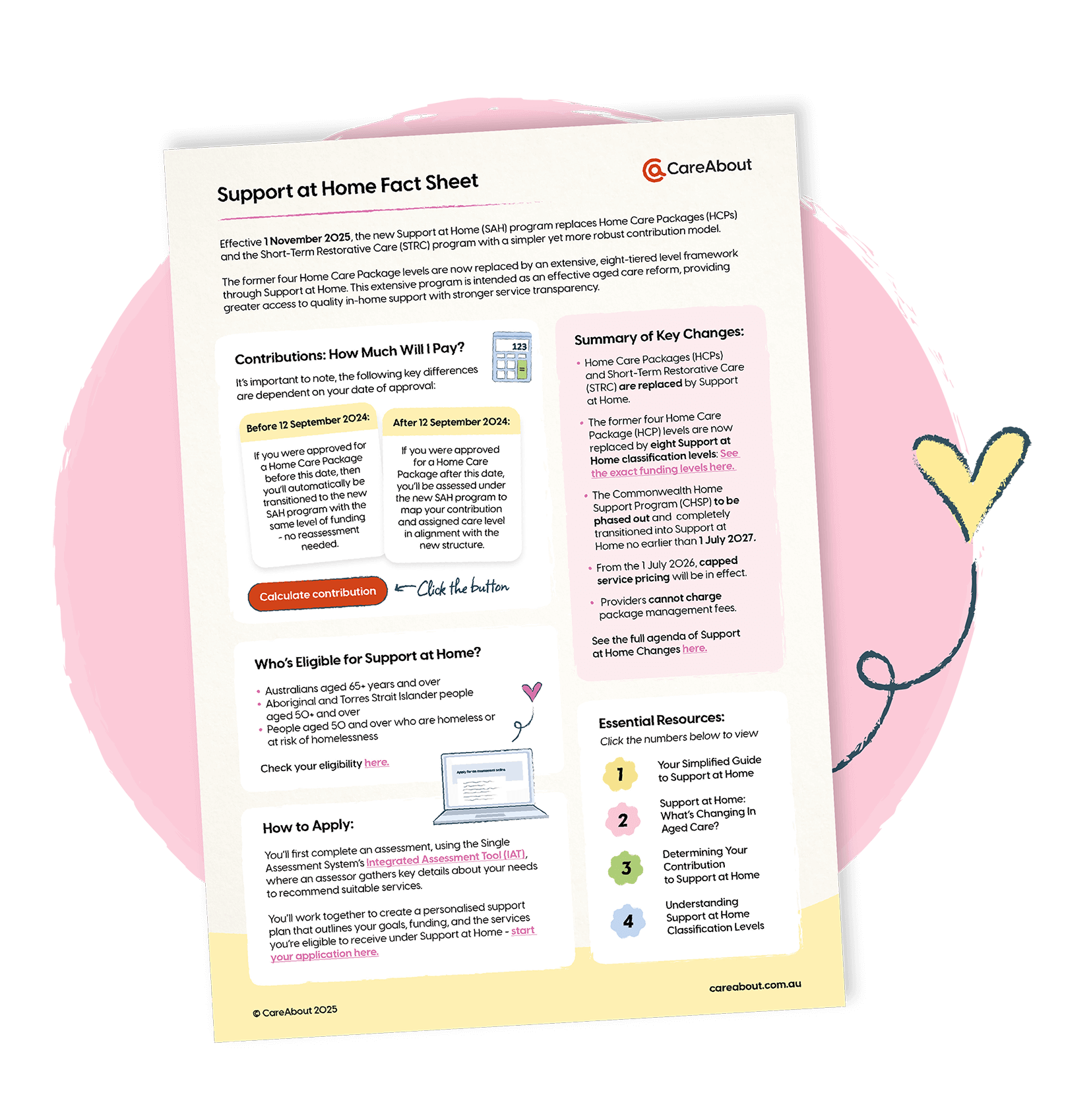
Your Fast Fact Sheet to Support at Home
We’ve compiled your fast guide to find the essential information you need to know about Support at Home.
Everywhere from determining your contribution, reviewing the key changes from Home Care Packages (HCPs), what this new aged care reform means for you, and so much more.
Simply download your guide at the button below.
Frequently Asked Questions (FAQs)
Yes, specialised items like wound dressings, oxygen consumables, and continence pads can be covered under nursing care consumables when clinically required.
Routine items a nurse would ordinarily carry are included in the provider’s service price rather than billed separately.
Yes. Telehealth nursing, including medication prompts or remote reviews, can be funded when clinically appropriate.
Allied health covers distinct professions with different scopes of practice. Approvals align to assessed need for each discipline rather than a blanket approval.
Any intervention within a clinician’s scope that maintains or restores physical, cognitive, or functional ability, such as physiotherapy, occupational therapy, or speech pathology, can be covered if it contributes to safety or independence.
Only prescribed dietary supplements are eligible. General nutritional shakes or weight-loss replacements are not covered unless prescribed by an accredited dietitian or relevant clinician.
Only in rare circumstances, such as preventing homelessness or maintaining communication for aged care service access. Entertainment or personal communication costs are not covered.
No. Cleaning minor pet-related messes as part of normal housework may be included, but dedicated pet services such as feeding, grooming, or vet visits are excluded.
Yes, for small safety-related repairs like fixing taps, replacing batteries, or cleaning gutters. Large renovations or aesthetic improvements are out of scope.
Yes, when delivered by qualified professionals such as physiotherapists or occupational therapists, provided the group program supports mobility, strength, or social participation relevant to the care plan.

Your Trusted Guide to Quality Aged Care
Since our foundation in 2014, we’ve helped over 135,000+ families throughout Australia to find just that – quality aged care.
We were established by two founders in the same boat as too many Australians: Looking for quality care for their loved ones – and no idea where to begin.
We built CareAbout as a free solution to help people navigate the system and find the right aged care support they deserve and need. .