


 Why do we need this? So we can get in touch and help find you nursing homes for your needs.


100% Obligation Free
Zero Additional Cost to You
Support at Home Classification 5 is designed for older Australians who require frequent, multifaceted support to remain living independently. It provides a higher funding allocation to support a coordinated mix of personal care, allied health services, and assistance with daily tasks – all tailored to individuals with more complex care needs.
With an annual budget of $39,697.61 (or $9,924.40 quarterly), Classification 5 helps cover services that address both physical and functional health challenges. This includes regular help with bathing and dressing, transport to medical appointments, meal preparation aligned with dietary needs, and ongoing allied health input.
It’s ideal for people living with multiple health conditions who require care that’s not yet at a clinical or nursing-home level – but is beyond what lighter Support at Home Classification budgets can manage.
Support at Home Classification 5 is well-suited for people who:
This classification ensures that support is not just reactive – it’s proactive, holistic, and designed to help avoid hospitalisations or premature residential care.
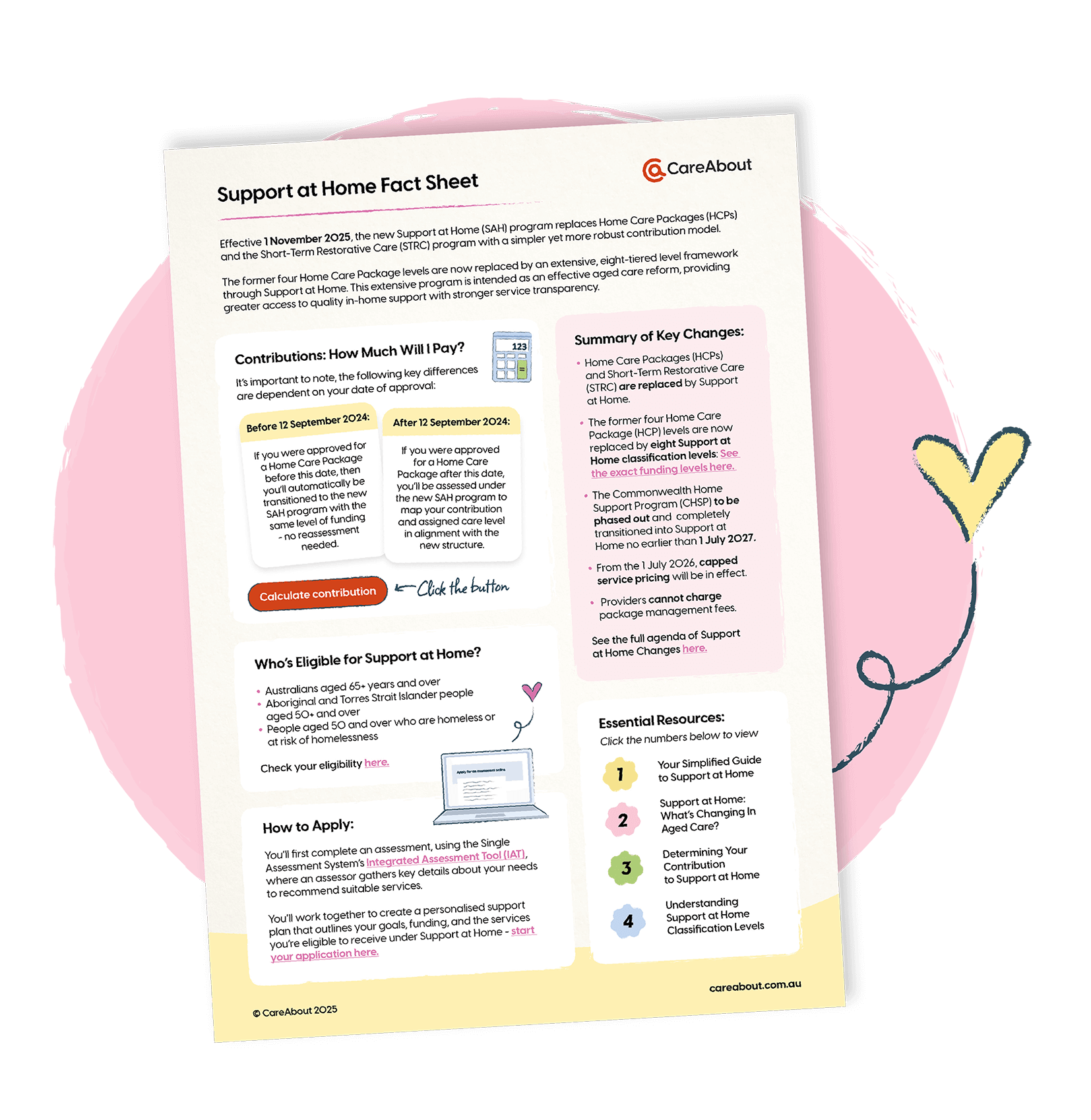
We’ve compiled your fast guide to find the essential information you need to know about Support at Home.
Everywhere from determining your contribution, reviewing the key changes from Home Care Packages (HCPs), what this new aged care reform means for you, and so much more.
Simply download your guide at the button below.
Support at Home Classification 5 gives recipients access to a comprehensive suite of services. These are some of the key areas of support:Personal Care and Assistance
Regular help with essential daily activities, including:
Classification 5 enables access to ongoing allied health care, such as:
To keep the home clean, safe, and manageable:
To maintain social connection and ensure access to essential appointments:
At this level, oversight becomes more structured:

John, aged 82, has diabetes, arthritis, and recently recovered from a fall. He lives alone and finds it difficult to manage her household and health appointments on his own.
With Support at Home Classification 5, John receives:
This structure has allowed John to stay safely at home while maintaining his health and connections.
You can roll over up to $1,000 or 10% of your quarterly funds for future needs, like respite care or unexpected health changes.
| Quarterly Budget | Annual Budget | |
|---|---|---|
| Level 5 | $9,924.40 | $39,697.61 |
Applying for Support at Home is straightforward, and you don’t need to navigate it alone. Here’s what to expect:
Begin by getting in touch with My Aged Care – the government’s central point for aged care services.
A quick initial screening will confirm if you’re eligible for a formal assessment
Register online at myagedcare.gov.au or call 1800 200 422
If eligible, you’ll be referred for a full in-home assessment using the Integrated Assessment Tool (IAT).
This assessment looks at your current health, mobility, home setup, and support needs
You may have a friend, family member, or advocate with you during the assessment
After your assessment, you’ll receive a Notice of Decision that includes:
Your Support at Home classification and the level of funding assigned
A care plan that outlines recommended services and goals
Information about short-term supports if applicable
Your care needs will be ranked as urgent, high, medium, or standard. This determines how quickly you receive funding.
Once your funding becomes available you’ll have 56 days (or up to 84 days with an extension) to choose an approved provider

When you don’t have all the pieces of a constantly-changing puzzle, it’s incredibly hard to make an informed decision – that’s where we come in.
Our Care Advisors cut through the noise, and simplify an otherwise complex process. We take the time to understand who you are, and what you need. We then present you with an expert-led recommendation – of course, the ultimate choice is yours to make.