


 Why do we need this? So we can get in touch and help find you nursing homes for your needs.


100% Obligation Free
Zero Additional Cost to You

Support at Home Classification 8 represents the highest level of in‑home care under the program. It is designed for older Australians who require very intensive support to remain at home – often with complex health conditions, high service needs, and ongoing daily assistance.
This classification carries an annual budget of $78,106.04 (or $19,526.51 per quarter) according to your reference figures. It enables frequent, coordinated care across multiple disciplines: personal carers, nursing staff, allied health professionals, and more.
The objective is to help people live with dignity, preference and as much independence as possible – even when their support needs are significant.
This Classification is suitable for eligible Support at Home recipients who:
Classification 8 is the highest of the eight Support at Home classifications, and is only suited for those whose care needs are complex and/or extensive. It is suited for those who require the most comprehensive in‑home support plan, in order to both maintain their safety and their ability to continue residing at home with stronger assistance.
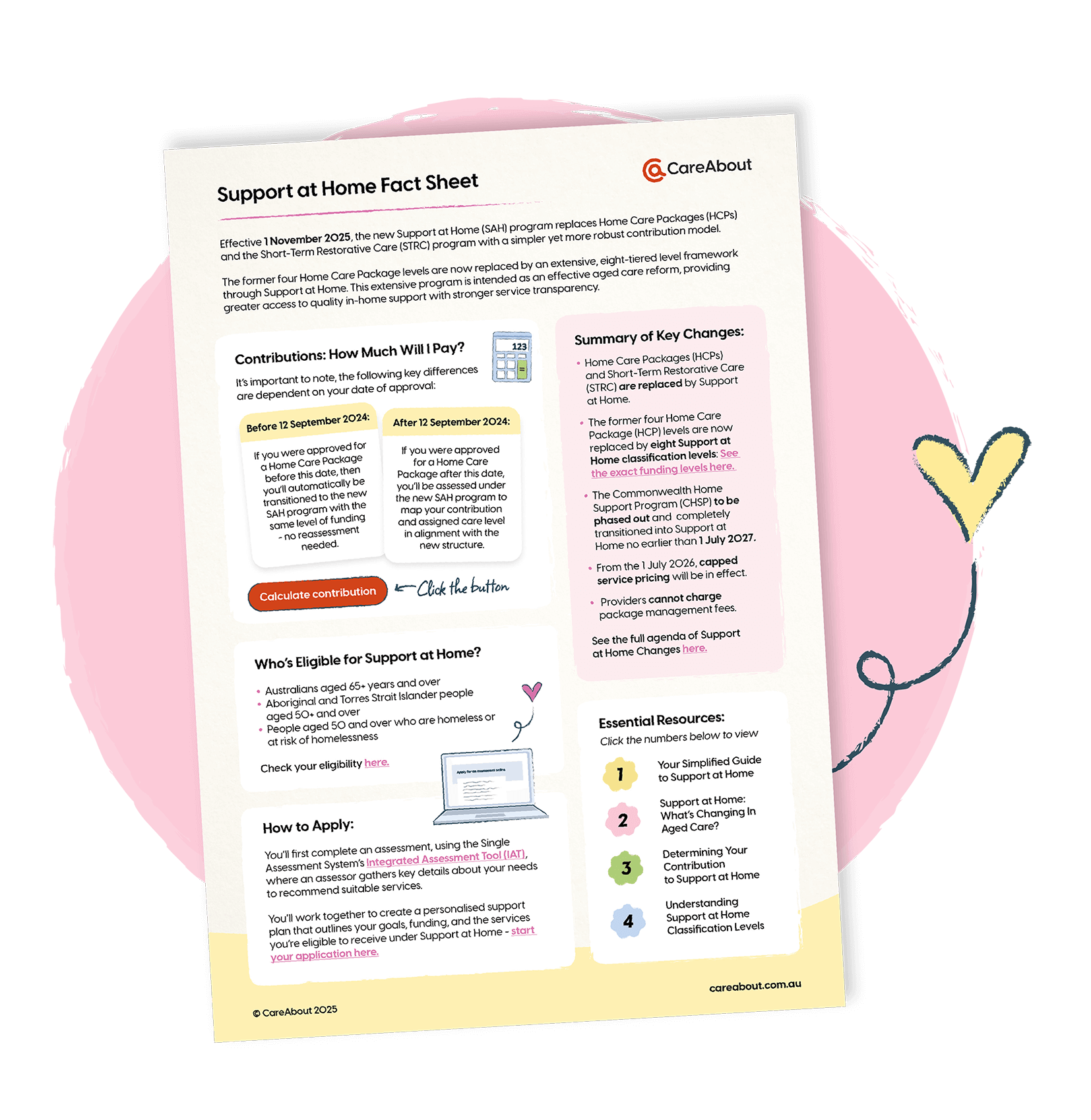
We’ve compiled your fast guide to find the essential information you need to know about Support at Home.
Everywhere from determining your contribution, reviewing the key changes from Home Care Packages (HCPs), what this new aged care reform means for you, and so much more.
Simply download your guide at the button below.
At this level, you’ll receive a rich and integrated mix of services – personal care, clinical care, allied health, equipment, environment support, social and emotional wellbeing. Frequent, often daily or multi‑visit support is common.

Helen, aged 88, lives alone but uses a hoist for transfers, has advanced heart failure, dementia and limited mobility. Her children live interstate and visit occasionally.
With a Support at Home Classification 8, Helen can:
Because of this classification level of support, Helen remains at home, surrounded by care and dignity, rather than needing to move into residential aged care prematurely.ed through Classification 7, Brian can continue to now reside safely at home, to remain connected with his family and community, and to ultimately, avoid unnecessary residential care.
Here, you can carry over up to $1,000 or 10% of your quarterly budget (whichever is greater) into the next quarter to cover unexpected service needs.
| Quarterly Budget | Annual Budget | |
|---|---|---|
| Level 8 | $19,526.51 | $78,106.04 |
Applying for Support at Home is straightforward, and you don’t need to navigate it alone. Here’s what to expect:
Begin by getting in touch with My Aged Care – the government’s central point for aged care services.
A quick initial screening will confirm if you’re eligible for a formal assessment
Register online at myagedcare.gov.au or call 1800 200 422
If eligible, you’ll be referred for a full in-home assessment using the Integrated Assessment Tool (IAT).
This assessment looks at your current health, mobility, home setup, and support needs
You may have a friend, family member, or advocate with you during the assessment
After your assessment, you’ll receive a Notice of Decision that includes:
Your Support at Home classification and the level of funding assigned
A care plan that outlines recommended services and goals
Information about short-term supports if applicable
Your care needs will be ranked as urgent, high, medium, or standard. This determines how quickly you receive funding.
Once your funding becomes available you’ll have 56 days (or up to 84 days with an extension) to choose an approved provider

When you don’t have all the pieces of a constantly-changing puzzle, it’s incredibly hard to make an informed decision – that’s where we come in.
Our Care Advisors cut through the noise, and simplify an otherwise complex process. We take the time to understand who you are, and what you need. We then present you with an expert-led recommendation – of course, the ultimate choice is yours to make.