






 Why do we need this? So we can get in touch and help find you nursing homes for your needs.


100% Obligation Free
Zero Additional Cost to You
For many older Australians, needing additional health support is common, but that doesn’t mean, you need to leave home. With the Australian Government’s aged care reform, the new Support at Home Program, which commenced on 1 November 2025, eligible care recipients have access to nursing, therapy and health services in their place of residence.
Clinical care is delivered or supervised by qualified health professionals and is fully funded by the Australian Government.
Clinical care under Support at Home helps you stay at home while still receiving the nursing, therapy and health support you need. Regular visits from nurses and allied health professionals can help manage long-term conditions, support recovery after illness or injury, and reduce the chances of needing an unplanned hospital stay.
By bringing clinical services to you, this support can make symptoms easier to live with, keep you safer and more mobile, and give you and your family confidence that your health is being monitored and adjusted as your needs change.
The clinical services you receive are decided in your aged care assessment and appear in your Notice of Decision and Support Plan. Your provider must deliver care that matches these approved needs.
Nursing care focuses on clinical tasks that support your health at home, such as wound care, medications and symptom management, so that you can manage ongoing conditions safely and avoid unnecessary hospital visits.
| What’s included | What’s not included |
|---|---|
| • Wound care and dressing changes. • Medication support, including prompts, administration and monitoring when approved. • Health checks such as blood pressure or blood glucose monitoring. • Continence and catheter care. • Pain and symptom support, including end-of-life comfort care. | • General GP or specialist medical consultations (these are funded through the health system, not Support at Home clinical care). • Hospital-based treatments and procedures. • Services that are not clinically necessary or not listed in your Support Plan. |
Nursing care can be delivered through home visits or, when suitable, by telehealth for simple check-ins or medication prompts. Nursing consumables such as basic dressings, bandages and antiseptics are included in the service price and are not charged to you separately.
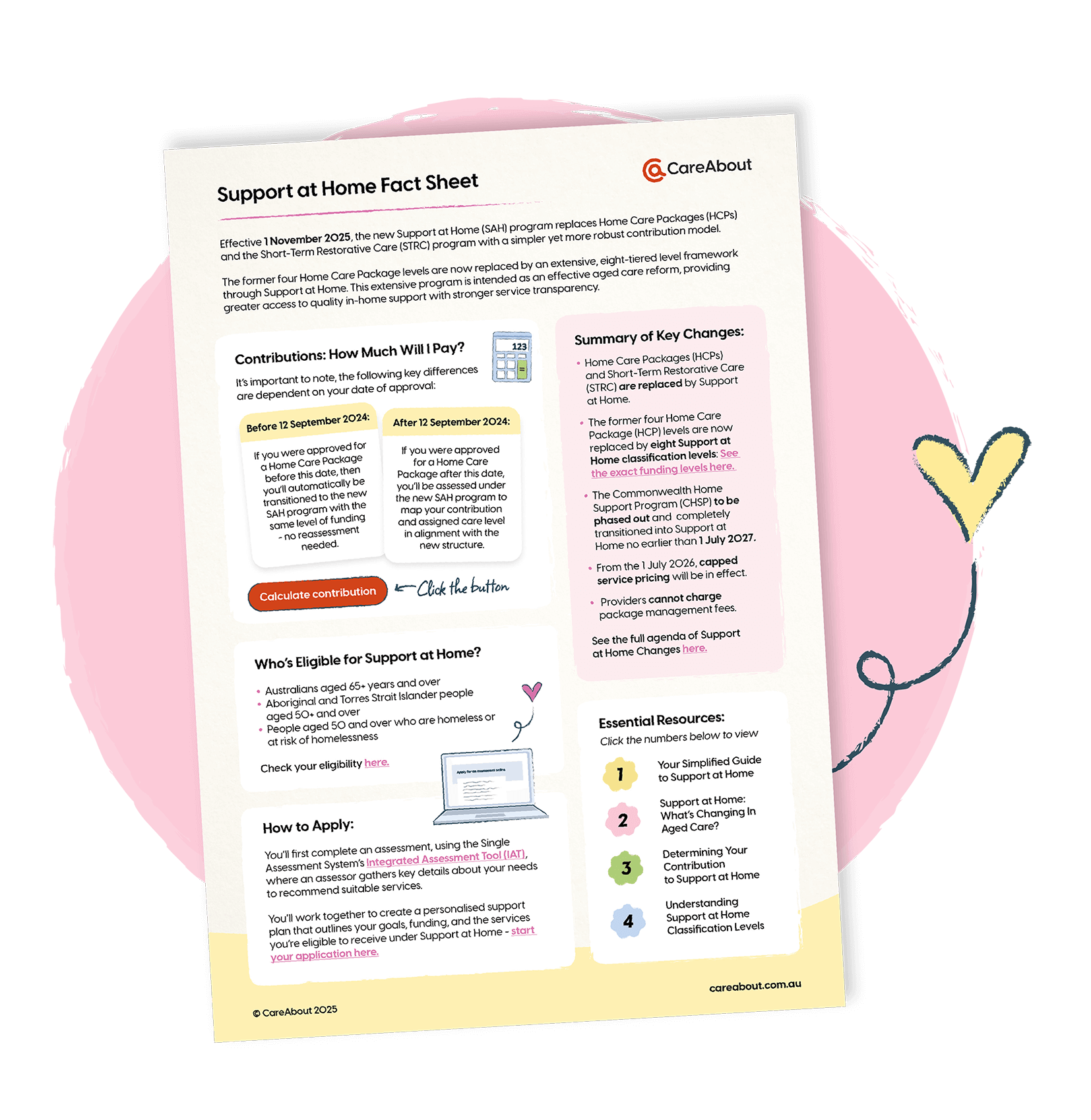
We’ve compiled your fast guide to find the essential information you need to know about Support at Home.
Everywhere from determining your contribution, reviewing the key changes from Home Care Packages (HCPs), what this new aged care reform means for you, and so much more.
Simply download your guide at the button below.
Allied health and therapy services help you maintain or improve your mobility, function, communication and wellbeing so you can continue to perform everyday activities safely at home – and within your community.
| What’s included | What’s not included |
|---|---|
| • Physiotherapy or exercise physiology for strength, balance and mobility. • Occupational therapy for safer daily activities and home set-up. • Speech pathology for swallowing and communication. • Podiatry for foot care and balance. • Dietitian or nutritionist advice for healthy eating and medical diets. • Psychology, counselling or social work for emotional wellbeing. • Culturally safe clinical services from Aboriginal and Torres Strait Islander health practitioners or workers for First Nations people. | • General gym or pool memberships (even if you exercise there). • Services that are purely for relaxation or beauty and not part of an approved clinical goal. • Therapy not prescribed in your Support Plan or outside the provider’s scope of practice. |
Where therapy needs to occur in a gym or pool, entry costs can be included in the provider’s price or paid by you, but ongoing memberships are not funded. Group programs such as hydrotherapy or exercise classes can be included when they are delivered by an appropriate professional and linked to your approved clinical goals.
Care management and coordination ensure your clinical services and home supports work together, so that appointments are organised, information is shared and your plan is updated when your needs change.
| What’s included | What not included |
|---|---|
| • Planning and coordinating your clinical and home support services. • Checking progress against your goals and updating your care plan. • Liaising with your GP, specialists and other providers. • Requesting a Support Plan Review when your needs change. | • Services that duplicate what your GP or hospital team is already responsible for. • Any coordination not linked to services in your Support Plan. |
Your allocated Care Partner usually leads this coordination, working with you, your family if you wish, and your clinicians so that everyone is clear about who is doing what and when to adjust your plan.
Clinical care is provided in your home or in your local community. It may include home visits, telehealth sessions or coordination with your GP or specialist.
Providers must be registered for the services they deliver, meet the strengthened Aged Care Quality Standards, and cannot charge more than the amount you have agreed to.
Ruth, 79, went home after a fall. Now, a nurse visits twice a week for wound care, while a physiotherapist helps Ruth to walk safely using a frame. As Ruth improves, her allocated Care Partner will reduce the number of visits, so Ruth keeps her confidence without paying for support she no longer requires.
Your care plan is created with your allocated Care Partner (this is a staff member from your chosen provider whose responsibility is to effectively manage your care) and, if you wish, your family or carer. Your care plan is guided by both your Notice of Decision and your Support Plan, and sets out your goals, services and who coordinates them.
Your plan is a living document. If your health improves, your services can reduce. If your needs grow, your provider can request a Support Plan Review so that your care and Support at Home funding keep pace with your situation.
Clinical services under Support at Home are fully funded by the Australian Government. You do not pay for nursing, physiotherapy or other allied health approved in your plan.
If you also receive independence services, such as personal care or mobility support, or everyday living services, such as cleaning, meals or shopping, you may contribute a small percentage of those costs based on your income and assets.
You can learn more about this in our Support at Home contributions guide.

We’re here to help Australians navigate aged care with confidence, because no one should ever have to face this journey alone.
We’re not a provider, but we’re here to match you with the right one. With over 900+ providers Australia-wide, finding quality aged care is stressful and overwhelming. That’s why we 1:1 match you with only a trusted, compliant provider from our handpicked panel of only vetted providers – based on your unique needs.
If you are recovering after illness, injury or a hospital stay, you may be approved for up to 16 weeks of intensive support with a budget of about $6,000, with up to another $6,000 if needed. You can access up to two episodes in 12 months. Clinical services delivered through this pathway are fully funded and require no contribution.
If a doctor or nurse practitioner has assessed that you have around three months or less to live, the End-of-Life Pathway provides $25,000 over 12 weeks for clinical and home care. If funds remain, support can continue up to week 16. Clinical and nursing services are fully funded with no contribution.
For an overview of how these short-term supports sit alongside your ongoing funding, see our Support at Home classification levels guide.
Your clinical care is guided by national standards and evidence-based frameworks so that you receive safe, high-quality care at home. Clinicians use national guidance that focuses on recovery, mobility and confidence, with tailored approaches for people at risk of falls, living with frailty or dementia, or needing nutritional or mental health support. Clinicians always apply professional judgement to tailor care to your situation and goals.
For people in the End-of-Life Pathway, the focus is on comfort, dignity and family involvement. The Australian Government funds national training for aged care workers and nurses in palliative care, symptom management and family support. These programs help your care team to keep you comfortable and supported at home.
These quality measures are part of the broader aged care reform that aims to strengthen safety, choice and consistency. To learn more about this aged care reform, see our Support at Home changes page.
You have clear rights under Support at Home. In practice, this means:

When you don’t have all the pieces of a constantly-changing puzzle, it’s incredibly hard to make an informed decision – that’s where we come in.
Our Care Advisors cut through the noise, and simplify an otherwise complex process. We take the time to understand who you are, and what you need. We then present you with an expert-led recommendation – of course, the ultimate choice is yours to make.