






 Why do we need this? So we can get in touch and help find you nursing homes for your needs.


100% Obligation Free
Zero Additional Cost to You
When you need a hand with day-to-day tasks, this doesn’t mean you’re losing your independence.
The Australian Government’s Support at Home program funds practical help so that you can continue to live safely and confidently at home while staying connected to your community.
Independence services cover personal care, social connection, transport and respite for carers. The focus is on supporting your routines, confidence and participation, in the way that works for you.
Your aged care assessment sets out exactly which services you can receive. These appear in your Notice of Decision and Support Plan, and your provider must deliver only what has been approved.
Respite gives your usual carer a short break while you continue receiving safe, respectful support at home or in a community setting.
Transport
How it differs from Everyday Living: Independence services support you with daily activities and participation. Everyday Living services keep your home clean, safe and workable, for example cleaning, meals and minor home maintenance.
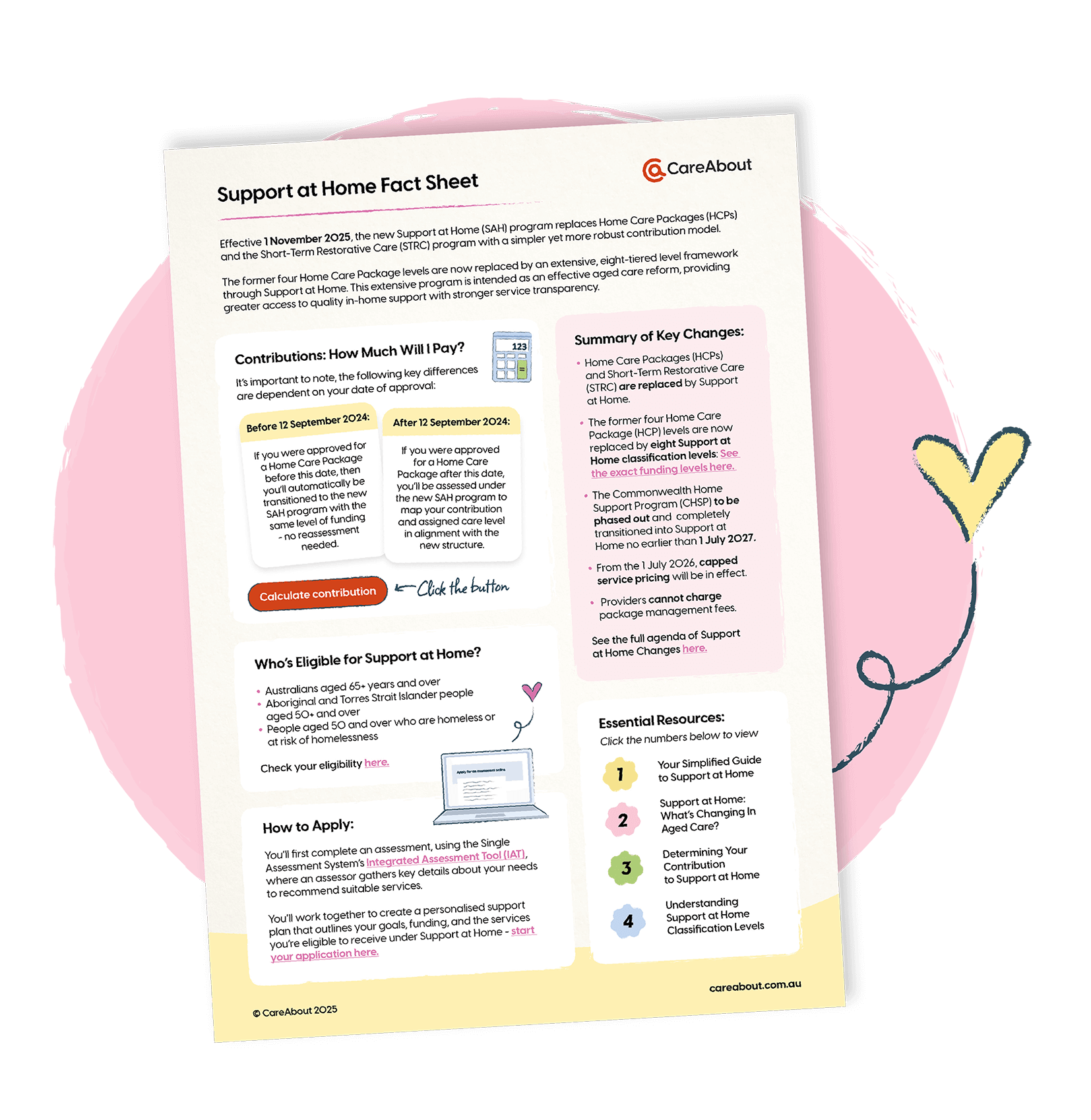
We’ve compiled your fast guide to find the essential information you need to know about Support at Home.
Everywhere from determining your contribution, reviewing the key changes from Home Care Packages (HCPs), what this new aged care reform means for you, and so much more.
Simply download your guide at the button below.
Assistive Technology and Home Modifications (AT-HM)
If equipment or changes to your home would help you live more safely, you may be approved for the Assistive Technology and Home Modifications (AT HM) scheme. This can include grab rails, ramps, mobility devices or bathroom changes to reduce falls risk and make tasks easier.
Who pays what: AT HM items usually follow the same contribution rules as independence services, so you may pay a portion of the item or modification cost. Prescription and wrap-around services, such as clinical assessment, safe installation or training to use the equipment, are treated as clinical supports and are fully funded with no contribution required.
For a full picture of how AT-HM sits alongside your ongoing funding, see our Support at Home classification levels guide.
What Will You Pay
Independence services are subsidised. Your contribution depends on your income and assets as assessed by Services Australia.
You only pay for services that are actually delivered:
Clinical services, such as nursing and allied health, are fully funded for everyone. There is no contribution for clinical supports – learn more about how contributions are set in our Support at Home contributions guide.
It’s important to note: If you were approved for a Home Care Package on or before 12 September 2024, the no worse off principle applies, so your fees will stay the same or be lower when you move to Support at Home.
You will work with a Care Partner and, if you wish, a family member or carer to decide what matters most and how support can help.
Here are some examples of situations where independence services can be utilised:
Your plan is not set and forget. If your needs change, your care partner can request a Support Plan Review so services and funding stay right sized for you.
Vera, 81, lives alone. She has help with showering on three mornings each week, transport to the shops once a fortnight and two hours of respite so her son can rest. When Vera’s confidence improves, her plan will be adjusted.
You are protected, seen, and heard – and it’s integral to remember that. Feeling pressured, rushed, or taken advantage of is not the norm nor should it be tolerated.
It’s important to be aware:
Independence services are practical help that keeps you doing the things that matter, in the place that feels most like you: Your home.
With flexible support, the right equipment and a plan that adapts, many people stay at home for longer instead of moving into residential care earlier than they would like.
Since our foundation in 2014, we’ve helped over 135,000+ families throughout Australia to find just that – quality aged care.
We were established by two founders in the same boat as too many Australians: Looking for quality care for their loved ones – and no idea where to begin.
We built CareAbout as a free solution to help people navigate the system and find the right aged care support they deserve and need. .
CareAbout helps older Australians and families understand the Support at Home system and connect with reliable, high quality providers.
We can help you find personal care, social support, transport, respite and access to assistive technology and home modifications that fit your goals and budget.
Speak to a CareAbout expert today and get matched with a provider who can support your independence at home.