






 Why do we need this? So we can get in touch and help find you nursing homes for your needs.


100% Obligation Free
Zero Additional Cost to You
Please note: The content below refers to the Support at Home changes which replaced Home Care Packages on 1 November 2025.
Under the old Home Care Packages (HCPs), many people liked to pick and choose their own arrangement. For example, you may have had a primary provider to handle the administration, but used a local cleaning company you knew well, a separate gardening service, and/or a nurse recommended by a friend.
Under the new Support at Home program, this has all changed.
Since the new system launched, the government has enforced the Support at Home Single Provider model. Regardless of your specific Classification Level, you must now be linked to one single provider for all your ongoing care. This means one organisation is responsible for everything, everywhere from your nursing and equipment to your domestic assistance.
The answer isn’t just about paperwork. It is about your safety.
Under the Aged Care Act, your provider is legally responsible for your health outcomes. If you have three different providers, there is a risk that no single person has the full picture of your health. The Single Provider model ensures that one Care Management team oversees everything to prevent gaps in your care.
There is also a financial reason. Under the current system, the 10% Care Management fee deducted from your budget is “pooled” by the provider. This pooling happens at a specific level called the aged care service delivery branch. If you were allowed to split your funding across multiple providers, this pooling mechanism would break. This would also complicate how contributions are calculated and collected.
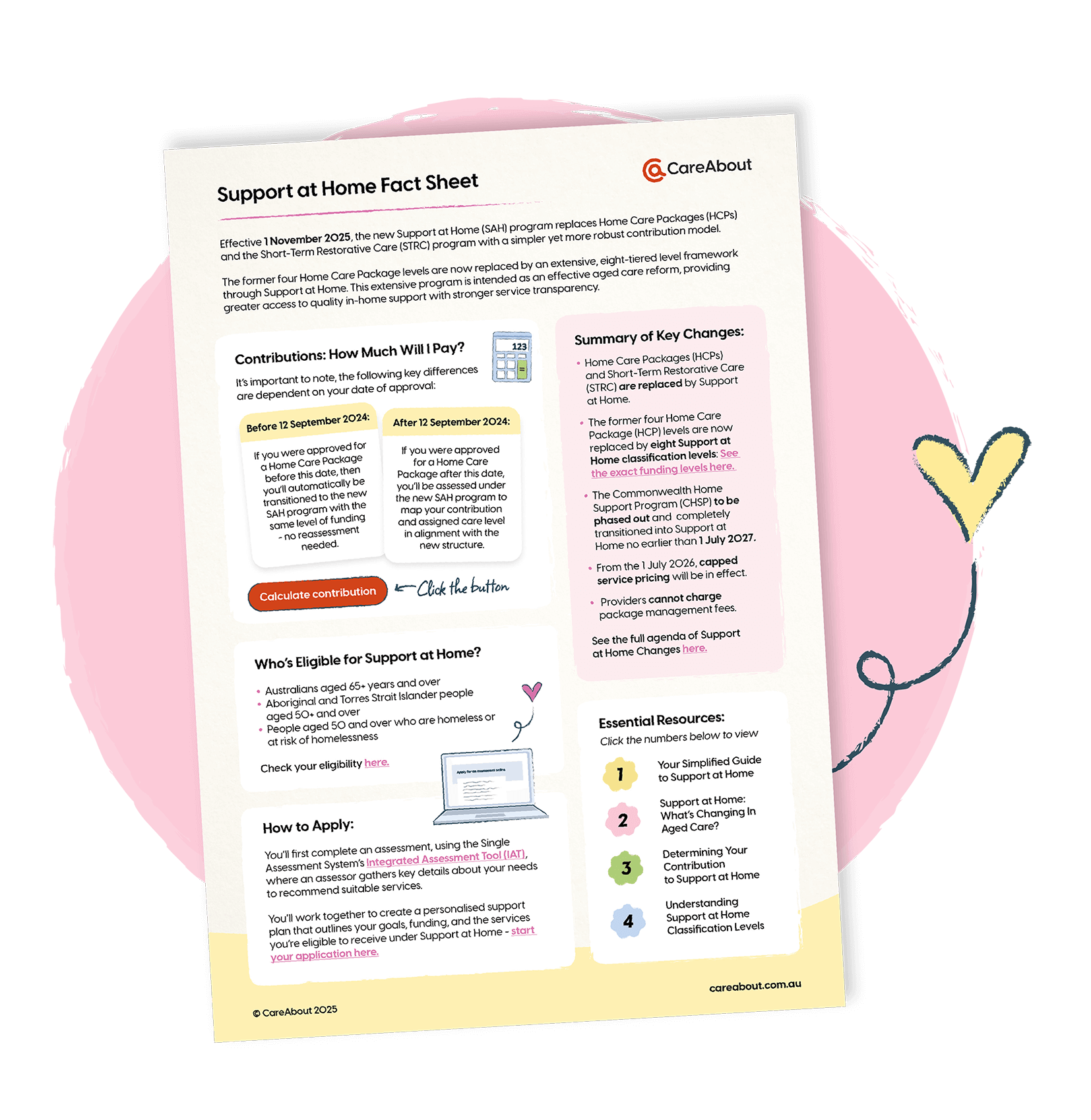
We’ve compiled your fast guide to find the essential information you need to know about Support at Home.
Everywhere from determining your contribution, reviewing the key changes from Home Care Packages (HCPs), what this new aged care reform means for you, and so much more.
Simply download your guide at the button below.
If you value choice and want to bring in your own workers, the best pathway is often Self-managed care.
The government rules allow self-managed aged care providers to support you to find your own workers. In this model, you find the worker, but your Single Provider still pays the invoice to ensure everything is tracked correctly.
The Fee Cap Protection
There is a specific consumer protection rule for this. If you find your own worker under a self-management agreement, the provider is capped at charging a maximum 10% overhead on top of the invoice cost. This covers their administrative costs for checking the worker’s compliance.
While the Single Provider rule is strict, there are limited exceptions where you can access care from a different organisation. These might include but are not limited to:
You might see the term “Service Delivery Branch” in your paperwork.
A large provider might have multiple branches. For example, they might have “SunnyCare North” and “SunnyCare South”. You must be linked to one specific branch.
Why it matters: Your care management funds are pooled within that specific branch. If you move house to a new region, you might technically have to “change providers” or transfer branches even if you stay with the same company. This ensures your funding moves to the correct local pool.

Since our foundation in 2014, we’ve helped over 135,000+ families throughout Australia to find just that – quality aged care.
We were established by two founders in the same boat as too many Australians: Looking for quality care for their loved ones – with no idea where to begin.
We built CareAbout as a free solution to help people navigate the system and find the right aged care support they deserve and need.
Another term you might encounter is associated provider aged care. This refers to an organisation that delivers services on behalf of your Single Provider.
For example, a smaller community provider might not have their own nurses, so they contract a large nursing agency to be their “Associated Provider”.
Consumer Rights: You have a right to know who is actually walking through your door. Your Care Plan must clearly state if a service is being delivered by a third party.
If you transitioned from a Home Care Package last November and are still using multiple different agencies informally, you may be at risk.
The Single Provider rule is a big shift designed to improve safety. However, it requires better communication between you and your provider.
If you have specific independent workers you want to keep, you do not necessarily have to lose them. You just need to find a provider that supports Self-Management and is willing to onboard your preferred team.
Need help navigating the changes? Contact CareAbout to find a provider that supports your choice and control.

When you don’t have all the pieces of a constantly-changing puzzle, it’s incredibly hard to make an informed decision – that’s where we come in.
Our Care Advisors cut through the noise, and simplify an otherwise complex process. We take the time to understand who you are, and what you need. We then present you with an expert-led recommendation – of course, the ultimate choice is yours to make.