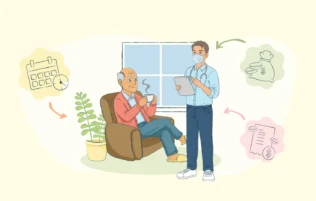
Navigating Your ACAT Assessment and Reassessment

Whether you’re preparing for your first assessment or waiting to be reassessed, knowing what to expect can make a real difference to the outcome.
An ACAT (Aged Care Assessment Team) assessment can feel daunting and overwhelming, especially when you’re in the middle of navigating a loved one’s changing needs.
In the follow-up to our previous blog, When My Aged Care Gets It Wrong: How to Fight Back for a Fair Assesment, we share the simple guide to navigating your ACAT assessment.
Here, we’ll walk you through the key questions that assessors ask, the traps to watch out for, and how to make sure you receive the right level of support.
First, What Is An ACAT Assessment?
The Aged Care Assessment Team (ACAT), otherwise known as the Aged Care Assessment Service (ACAS) in Victoria, carries out formal assessments Australia-wide to determine what level of government-funded aged care support a person is eligible for. This includes approval for Support at Home (SAH) and entry into residential aged care.
A reassessment may be triggered when a person’s needs change significantly, when they move between care levels, or as a routine review.
In some cases, people who were previously assessed under older frameworks, such as the Commonwealth Home Support Programme (CHSP), may be grandfathered into updated systems with different funding entitlements.
To learn more about what’s changed with Support at Home, please see our guide here.
Questions That Can Catch People Off Guard
ACAT assessors are trained to build a complete picture of a person’s daily functioning and safety at home.
The questions they ask go well beyond a simple health check, and some questions might even surprise those families who are unprepared. Here are the areas that are typically covered (but of course, are not limited to):
Physical Function & Mobility
- Can you walk around the shops without a mobility aid?
- Can you lift and carry groceries?
- Are you able to transfer in and out of a car independently?
- Do you get to the toilet in time?
Pro-tip: Be honest, vulnerable, and specific. Assessors are looking at real-life function, not best-case scenarios. To ensure you receive the funding your needs adequately require, it’s essential to share your true circumstances. For instance, if you, or your loved one, manages on good days but struggles on bad days, it’s important to make this known.
Daily Living & Self-Care
- Are you able to cook or prepare meals for yourself?
- Do you remember to take your medications?
Pro-tip: If your family member forgets medications, misses doses regularly, or needs reminders – this is critical information to share. Bring any printed medication lists from the GP to the assessment.
Cognitive Function & Memory
Memory and cognition are given significant weight in assessments, and rightly so. Here, assessors may ask:
- Have you ever got lost while driving in a familiar area?
- Do you lose track of days or times?
- Are you managing your finances independently?
- Can you read and follow written instructions?
Pro tip: If yourself, or your loved one, has documented memory concerns, bring print-outs from a GP and/or specialist. These help assessors understand baseline function and patterns of decline. Memory issues, including forgetting medications, days, and times, are considered carefully and can significantly influence the level of care approved. Alternatively, if you’ve been worrying more than usual about not being able to remember certain things, it’s crucial to be transparent and open up about this.
Health & Medical History
- What health conditions do you have?
- Have you been admitted to hospital in the last 12 months – and if so, why?
Pro-tip: Hospital admissions are an important indicator of health trajectory. Document all admissions, including the reason for each, and have this prepared with you.
Social Supports
- Do you have family or friends who support you?
Pro-tip: Be careful here. While it’s natural to want to present a positive picture, overstating informal supports can inadvertently reduce the level of formal care approved. Describe support honestly – including when family are not available, how often they can realistically help, and what tasks they actually do. Alternatively, if you don’t have any support – it’s important to be brave and share this too. At the end of the day, it’s about making sure you’re provided the support that only you need to continue residing safely at home.
What to Bring to the Assessment
Being well-prepared can significantly improve the outcome, which is why it’s important to consider bringing:
- A current medication list printed from the GP
- A summary of recent health conditions or diagnoses
- Details of any hospital admissions in the past 12 months
- Notes on day-to-day challenges – particularly around memory, medication, and mobility
- A trusted family member or carer who can speak to daily realities
The assessor may also ask whether your loved one would like to be referred for an Occupational Therapy (OT) assessment – this is worth discussing beforehand and is often very helpful in identifying assistive tech and home modifications’ (AT-HM) needs.
Understanding Care Levels and Funding
The outcome of an ACAT assessment determines which Support at Home Classification (Level 1 – 8) a person is approved for, or whether residential care is appropriate. This is distinct from the Commonwealth Home Support Programme (CHSP), which provides entry-level supports.
CHSP Vs Home Care Package: Know the Difference
Some people currently receiving supports under the CHSP, particularly those who have been in the system for a number of years, may be transitioning to the new Support at Home (SAH) framework. It’s worth understanding the financial implications of each pathway:
- CHSP tends to be lower cost to the individual, which is why some self-funded retirees prefer to remain on it.
- However, self-funded retirees on a Support at Home classification may actually access a higher dollar value of care for a similar or better financial outcome – it’s worth doing the numbers.
- Under the new Support at Home (SAH) program, individual contributions are being restructured. Understanding what your loved one will be asked to contribute, and how that compares to their current arrangement, is essential.
We recommend speaking with an aged care financial advisor to model out the best option for your family’s situation before making decisions about which pathway to accept. Alternatively, you may use our Support at Home calculator here to gauge what contribution you may be required to pay based on your personal circumstances.
Common Drawbacks to Avoid
- Downplaying difficulties to seem capable: Assessors need an accurate picture, not the best-case version, so it’s important to be real, and to share only your true situation.
- Not bringing supporting documents: A GP print-out on memory, medications, and/or special condition reports can be the difference in the classification level you’re allocated, which is why it’s crucial to come prepared with the required paperwork (if needed).
- Assuming CHSP is always the cheaper option: For self-funded retirees, running a comparison is worthwhile – see Sally’s story here to learn why Support at Home proved the better choice over CHSP.
- Not asking about Occupational Therapy (OT): An OT referral can unlock supports and home modifications that improve safety and independence where needed.
- Going alone: Having a trusted family member or friend present helps to ensure nothing is missed, especially for those with memory concerns.
After the Assessment: What Happens Next?
Following the assessment, your loved one will receive written notification of their approval and care level. If you feel the outcome doesn’t accurately reflect their needs, you have the right to request a review or appeal, where you can learn more about how to do this, in our guide here.
If approved for Support at Home, please keep in mind that wait times can vary. In the interim, CHSP services may continue. Once a classification level is allocated, you’ll need to choose a Support at Home provider to manage the funding on your behalf.
For those transitioning to the Support at Home framework, it’s important to ask specifically what your loved one will be required to contribute financially (we’ve built a free calculator here to help you) – and to get that in writing so there are no surprises.
Need help navigating an ACAT assessment? Or looking to explore your aged care funding options? We’re here to CareAbout You.
Navigating aged care can feel incredibly lonely, stressful and often overwhelming, especially with so much misinformation online. We’re here to cut the noise and help you find the answers you need.
Whether you need assistance for yourself or on behalf of a loved one, our team is always here to walk alongside you. Simply get in touch, and together, we can find the right path forward (completely free of charge).
We’ve helped over 135,000+ Australian families find vetted, suitable, and trusted Support at Home providers. Our expert-led aged care placement service is 100% free, 100% independent, and 100% personal.
How we help: We match you with providers based on your location, care needs, budget, and personal preferences. If you’ve been allocated funding, we’ll help you find the right provider well within your 56-day deadline. Already with a provider but ready for a change? We’ll make the transition seamless.
Ready to get started? Simply freecall us today at 13 13 00 and significantly reduce the time, stress, and uncertainty of organising Support at Home.