






 Why do we need this? So we can get in touch and help find you nursing homes for your needs.


100% Obligation Free
Zero Additional Cost to You
Most people hope to stay in their own home, where they can be close to loved ones and feel at peace, especially as life draws to a close.
Under the Australian Government’s new Support at Home Program, which commenced on 1 November 2025, the End-of-Life Pathway is now available. This pathway provides fast-tracked, additional help so you can be cared for at home with dignity.
The End-of-Life Pathway supports older Australians who have been medically assessed as having about three months or less to live and who choose to remain at home.
To be eligible, you generally need to:
A doctor or nurse practitioner must complete the national End-of-Life Pathway form to confirm these criteria and support your application.
First, a doctor or nurse practitioner completes an End-of-Life Pathway form, confirming your prognosis and functional needs. This form is available through My Aged Care.
If you’re already receiving Support at Home services, your provider can:
If you’re yet to apply for the Support at Home program, your GP, nurse practitioner or representative can request a high-priority End-of-Life assessment by simply:
You can be referred for this high-priority assessment even if you have never received Support at Home before (the End-of-Life Pathway is open to both new and existing participants).
An aged care assessor then reviews the form and confirms your eligibility so services can start as soon as possible.
The End-of-Life Pathway provides a one-off pool of funding that is intended to cover roughly the last three months of life at home.
| Funding aspect | What this means for you |
|---|---|
| Total budget | $25,000 End-of-Life funding |
| Period | 12 weeks of End-of-Life support |
| Maximum timeframe | Up to 16 weeks in total, if funds remain |
| Other My Aged Care funding | Replaced by this End-of-Life budget during this period |
| Number of times you can use it | One-off; the End-of-Life Pathway can only be used once |
If you need care beyond this time, your provider can request a review so that ongoing support may continue under an appropriate Support at Home classification, rather than under the End-of-Life Pathway.
Care is tailored to your individual preferences and needs. It can include a mix of clinical supports, independence services, and everyday living assistance.
Equipment and adjustments for comfort and safety, for example a hospital bed or oxygen, may be available through the Assistive Technology and Home Modifications (AT-HM) scheme where approved.
In some cases, you may also be able to access a separate budget for assistive technology under AT-HM, which can sit alongside your $25,000 End-of-Life funding. The exact supports depend on your assessment and the current AT-HM rules.
If you already have a Support at Home provider, you are encouraged to keep them if they can meet your needs under this pathway. Your Care Partner and yourself should both check that your current provider can deliver the level and type of End-of-Life support you require.
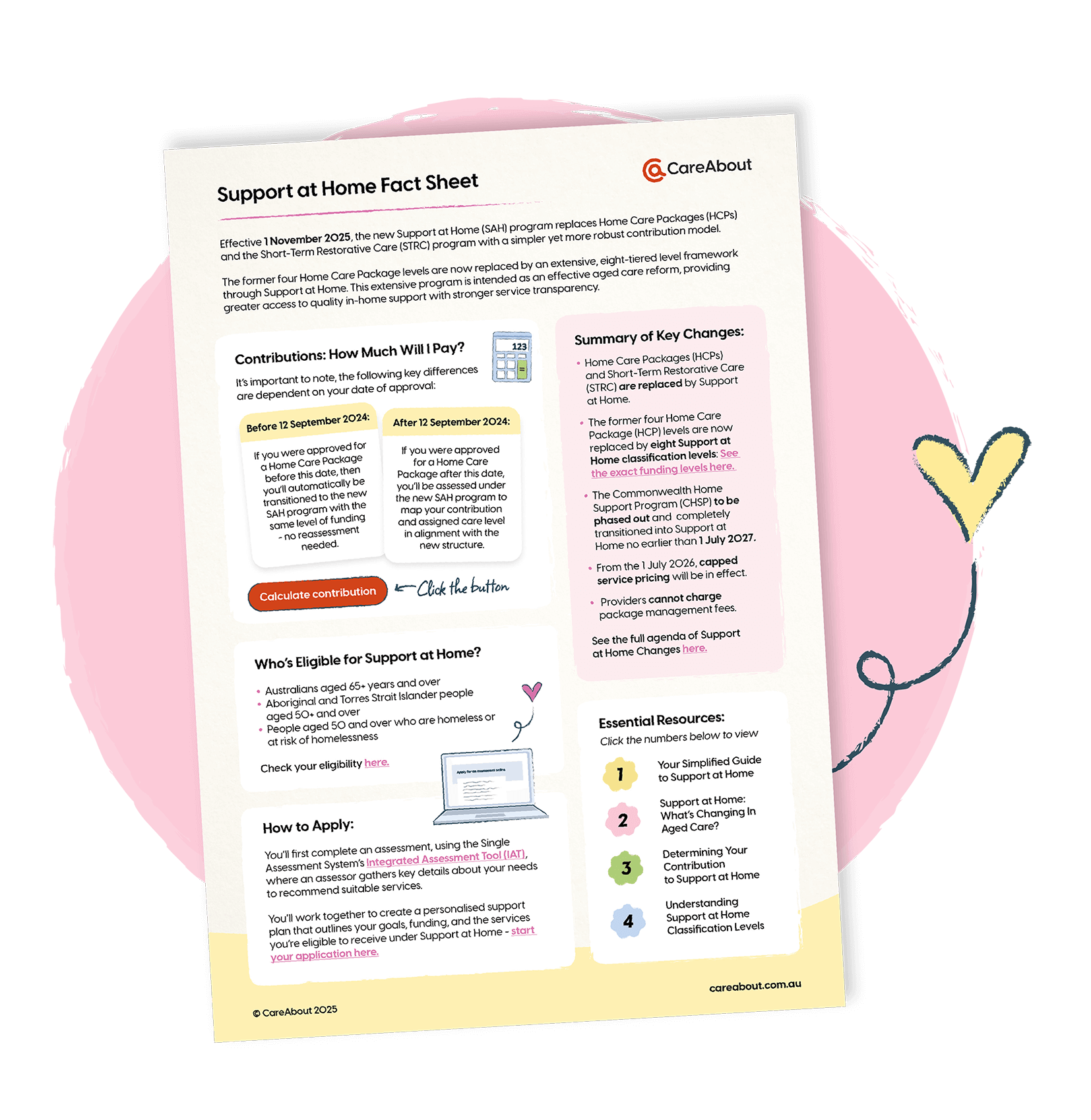
We’ve compiled your fast guide to find the essential information you need to know about Support at Home.
Everywhere from determining your contribution, reviewing the key changes from Home Care Packages (HCPs), what this new aged care reform means for you, and so much more.
Simply download your guide at the button below.
Clinical supports delivered under the End-of-Life Pathway are fully funded by the government. You do not pay a contribution for nursing, allied health or other clinical supports that are part of your approved End-of-Life plan.
Because the End-of-Life Pathway sits within Support at Home, you may be asked to contribute towards other types of services, depending on your income and assets.
In general:
Any contributions are set by Services Australia based on your personal income and assets and are only charged for services actually delivered.
If you were approved for a Home Care Package on or before 12 September 2024, the government’s ‘no worse off’ principle applies so you will pay the same or less when you transition.
To find out more, simply see our Support at Home contributions guide or use our Support at Home Contributions Calculator.
You have clear rights under the new aged care system.
In practice, this means:
Free, independent advocacy is available through the Older Persons Advocacy Network (OPAN) on 1800 700 600 if you need help understanding your rights or raising concerns.
The End-of-Life Pathway is for people who wish to spend their final months at home with comfort and dignity, rather than in hospital or residential care.

Bill, 82, had advanced heart failure. Bill’s GP completed the End-of-Life Pathway form so care could start quickly at home. Over 12 weeks, Bill received regular nursing visits, mobility aids and respite for his wife. He remained at home until his final days, surrounded by family, in the place he preferred: Home.
The pathway is also designed to work alongside government-funded palliative care services and, where relevant, voluntary assisted dying services. This allows symptom management, medications and specialist palliative input to continue while End-of-Life Pathway funding supports practical help at home.
If you or the person you care for needs support that is not covered by the End-of-Life Pathway, other options may include general or specialist palliative care services, moving into an aged care home, or using community-based supports that focus on end-of-life planning, values and preferences.
Carers can also seek support through counselling, peer support groups, and grief and bereavement services, so they are not coping alone during and after this time.
The End-of-Life Pathway is one of the program’s short-term options, alongside the Restorative Care Pathway and the Assistive Technology and Home Modifications (AT-HM) scheme. These initiatives are part of the government’s reform to make in-home aged care simpler, safer and more human-centred.
To find out more about Support at Home and what this aged care reform means for you, simply see our Support at Home: What’s Changing In Aged Care guide.
The End-of-Life Pathway helps you receive the right care, comfort and Support at Home, with clinical services fully funded and a clear plan that adapts to your needs during this precious time.
This short-term pathway offers families greater peace of mind that care can be arranged quickly and respectfully, so they can spend the remaining time with their loved one in the place they wish to go peacefully: At home.
Since our foundation in 2014, we’ve helped over 135,000+ families throughout Australia to find just that – quality aged care.
We were established by two founders in the same boat as too many Australians: Looking for quality care for their loved ones – with no idea where to begin.
We built CareAbout as a free solution to help people navigate the system and find the right aged care support they deserve and need.